If the Big Five is the whole point of the trip, book Tanzania. The Ngorongoro Crater and the Serengeti hold all five species between them, and a sensibly routed northern circuit takes you through both. Uganda has lion, leopard, elephant and buffalo in its savannah parks, but no wild rhino population — rhino are seen at a fenced sanctuary instead.
That is worth stating plainly before the rest of the comparison, because Uganda is a superb safari country for reasons that have almost nothing to do with the Big Five list.
One caveat underneath all of it: neither country's wildlife authority publishes sighting rates. Where a park is named against a species below, that is presence and habitat, not a forecast.
Can you actually see the Big Five in Uganda?
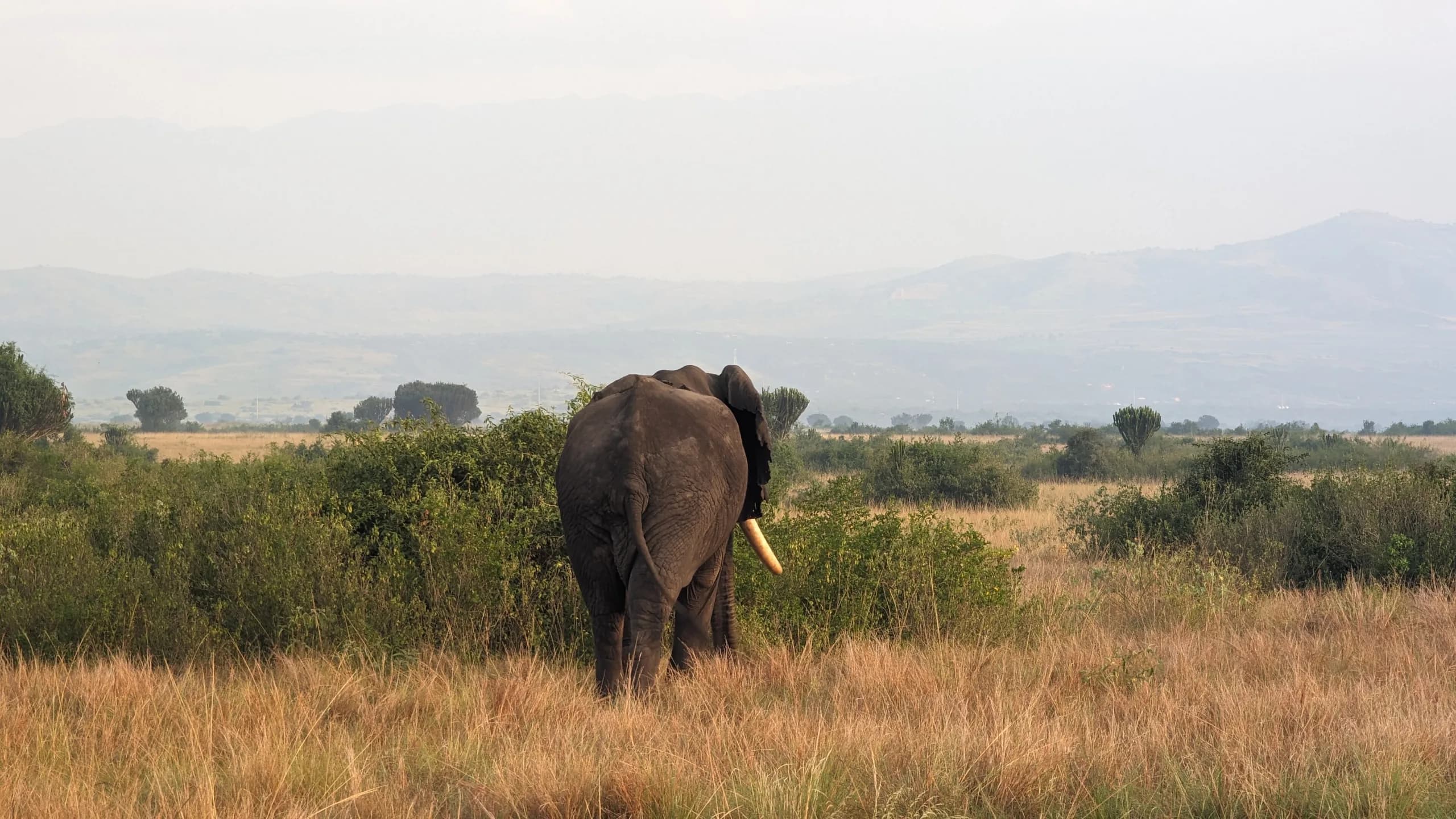
Four of them, in the wild. Murchison Falls, Queen Elizabeth and Kidepo Valley all hold lion, elephant and buffalo, and all three have leopard, though leopard is the one species nobody anywhere should promise you.
Rhino is the gap. Uganda has no wild rhino population, and the animals you can see live at Ziwa Rhino Sanctuary, a fenced breeding sanctuary on the road north to Murchison. You track them on foot with rangers, and you get far closer than any crater sighting. Whether that counts as a Big Five tick is your call, but it is a sanctuary, not a park population, and we would rather say so up front.
One line to watch rather than plan around: the Uganda Wildlife Authority's revised tariff, effective 1 January 2027, lists a rhino tracking fee for Ajai Wildlife Reserve at USD 20 per adult and USD 5 per child. UWA has published a price, not a product — nothing in its tariff documents says the activity is operating, or what rhino are at Ajai.
Where does Tanzania put the Big Five in one place?
The Ngorongoro Crater is the only place in this comparison where all five species are present inside one enclosed caldera. Lion, elephant and buffalo are the crater's staple game. Black rhino are present, and the crater is where a northern-circuit itinerary goes looking for them — usually at distance, across open grass, and never guaranteed. Leopard is the crater's weak card.
The Serengeti covers the rest: lion prides on the kopjes, elephant and buffalo through the central woodlands, and the riverine trees along the Seronera drainage, the habitat the northern circuit most associates with leopard. Rhino exist in the Serengeti but are rarely seen, and no itinerary should be built around them.
So the practical shape of a Tanzanian Big Five trip is: crater for rhino, Serengeti for leopard, everything else in both.
Uganda or Tanzania: a species-by-species comparison
| Species | Uganda | Tanzania (northern circuit) |
|---|
| Lion | Present in Murchison, Queen Elizabeth and Kidepo. Queen Elizabeth's Ishasha sector is known for lions resting in fig trees | Present in the Serengeti and the Ngorongoro Crater |
| Leopard | Present in all three savannah parks; sightings are hard-won everywhere | Present; the Serengeti's riverine woodland is the habitat most associated with leopard here |
| Elephant | Present in Murchison, Queen Elizabeth and Kidepo | Present in the Serengeti and the crater |
| Buffalo | Present in all three, including the reddish forest-savannah hybrids of Queen Elizabeth | Present in both |
| Rhino | None in the wild. Tracked on foot at Ziwa Rhino Sanctuary | Black rhino present; realistically a crater sighting, at distance |
| What the list adds up to | Four species in the wild, plus a sanctuary visit | All five present across one circuit |
If a complete wild Big Five is a hard requirement, the table settles it. If it is a nice-to-have, keep reading: the money points the other way.
What do the official park fees actually cost in each country?
These are government fees only; lodge, vehicle, guide and permits sit on top. Our guide to what an East African safari costs puts them into a whole-trip budget.
| Fee | Amount (foreign non-resident adult) | Set by |
|---|
| Murchison Falls entrance | USD 45 per 24 hours (child 5–15 USD 25; under 5 free) | UWA, Conservation Tariff July 2024–June 2026 |
| Queen Elizabeth, Kidepo Valley, Lake Mburo entrance | USD 40 per 24 hours (child USD 20) | UWA, same tariff |
| Launch cruise, Murchison, Queen Elizabeth or Lake Mburo | USD 30 per person, roughly two hours | UWA, same tariff |
| Small-boat minimum charge, Murchison and Lake Mburo | USD 120 minimum per small boat, whatever the party size | UWA, same tariff |
| Serengeti conservation fee | USD 70 per day peak (16 May–14 March); USD 60 low (15 March–15 May), each excluding 18% VAT — USD 82.60 and USD 70.80 with it. Child 5–15 USD 20; under 5 free | TANAPA, Tariffs 2023/2024 |
| Serengeti hotel concession fee, billed per person per night by your camp | USD 60 peak (July–September); USD 50 low (October–June), excluding 18% VAT | TANAPA, same tariff |
| Ngorongoro entry permit | USD 70.80 per person, valid for one entry within 24 hours (child 5–16 USD 23.60; under 5 free) | NCAA |
| Ngorongoro crater service fee | USD 295 per vehicle per descent | NCAA |
| Ngorongoro vehicle permit | USD 47.20 for a vehicle up to 2,000kg | NCAA |
Three things that catch people out:
- Tanzanian VAT. TANAPA's tariff book states that all charges exclude 18% VAT, which turns a USD 70 Serengeti day into USD 82.60. Confusingly, TANAPA's own website page says fees are VAT-inclusive. We treat the tariff book as authoritative and confirm the position before quoting.
- The Ngorongoro permit is single entry. It is valid for one entry within 24 hours, so an itinerary that passes through the conservation area twice pays the entry permit twice. Routing matters financially, not just logistically.
- These tariffs are older than they look. TANAPA's published book is the 2023/2024 edition; NCAA publishes no effective date and warns that tariffs change without notice; UWA's booklet covers July 2024 to June 2026, with the next changes due 1 January 2027. We confirm each figure when we quote.
The direction of travel is clear either way. Murchison Falls entrance is USD 45 a day; a Ngorongoro entry permit is USD 70.80 before the USD 295 crater service fee, and a peak Serengeti day is USD 82.60 with VAT.
Does the season change the answer?
Less than you would think, for the Big Five specifically. Neither country's resident game migrates out of the parks.
For Uganda, the Uganda National Meteorological Authority describes two rainfall seasons — March to May, and September through December — and notes that December to February is typically dry across the country, with February the hottest month. The catch is that northern and parts of eastern Uganda usually receive substantial rainfall in June, July and August, so Murchison and Kidepo do not get the clean mid-year dry window the gorilla forests in the south enjoy. Our guide to the best time to visit Uganda works through it month by month.
For Tanzania, TANAPA's fee calendar tells you how it reads its year. From 15 March to 15 May — the long rains — the Serengeti's conservation fee drops from USD 70 to USD 60 a day, and that window sits inside the low concession-fee season too, at USD 50 per person per night rather than USD 60. NCAA's Ngorongoro fees do not move with the season at all. You accept wet roads for the saving.
The Great Migration is a separate question from the Big Five and it moves on patterns that vary year to year — no authority publishes crossing dates, and anyone selling you a schedule is guessing. Our month-by-month migration guide sets out what is actually known.
What if you want gorillas and the Big Five?
Then the comparison stops being a competition. Uganda's argument was never the Big Five — it is gorilla trekking and chimpanzee tracking in the same country as savannah game, which Tanzania cannot offer at all. Rwanda pairs the same three things on a shorter road route, through Volcanoes, Nyungwe and Akagera. Uganda's case against it is a larger savannah offering — Murchison, Queen Elizabeth, Kidepo and Lake Mburo rather than a single park — at a gorilla permit of USD 800 against Rwanda's USD 1,500.
A Uganda gorilla permit is USD 800 per person for foreign non-residents, dropping to USD 600 in April, May and November — and a low-season permit cannot be rescheduled. Foreign residents, Rest-of-Africa and East African visitors pay less, and UWA has not published low-season rates for those categories. The permit covers the guide fee, park entrance for the day and a community development contribution, so park entrance is not charged again on top of it. UWA's revised structure taking effect on 1 January 2027 leaves gorilla tracking at USD 800.
Two booking rules differ by country and are often wrongly merged. In Uganda, foreign non-residents can buy gorilla and chimpanzee permits only through a tour operator licensed by the Uganda Tourism Board, and since 1 March 2026 there is no free hold period: a permit is secured only on full payment at the time of booking. Rwanda works differently — RDB permits can be booked directly, online through Irembo or the Visit Rwanda booking portal, as well as through an operator.
Combining Uganda with Tanzania is doable, but plan the paperwork early. The East Africa Tourist Visa costs USD 100 and covers Kenya, Uganda and Rwanda only — it gives you no entry rights to Tanzania, the Serengeti, Ngorongoro or Zanzibar. Tanzania is applied for separately on its own eVisa portal: USD 50 for the ordinary single-entry tourist visa, valid for stays of up to 90 days, while US passport holders must take the USD 100 multiple-entry visa instead. Tanzanian eVisa applications are processed within ten days. Uganda also requires a yellow fever certificate as part of the visa application itself, so book that appointment before you apply — confirm current requirements with Uganda's Directorate of Citizenship and Immigration Control and, for Tanzania, the Ministry of Health. Our guide to the East Africa Tourist Visa covers the detail.
Which should you book?
- A complete Big Five, first African safari, limited time. Tanzania. Look at a northern circuit.
- Gorillas, with savannah game as well. Uganda, and treat the Big Five as a Big Four. A Uganda grand circuit is the shape of it.
- You are cost-sensitive. Uganda. The daily government fees are lower, and the gorilla permit is USD 800 rather than Rwanda's USD 1,500.
- Leopard is the species you care about. Tanzania, in the Serengeti — the park most associated with leopard on this circuit, with no guarantee attached there or anywhere else.
- You want both. Fly Uganda then Tanzania, allow two visa applications, and give the trip enough days that neither half is a dash. See how many days a Uganda safari needs.
How we would plan it
We price every trip from the tariffs published on the day we quote, not from a brochure figure, because UWA, TANAPA and NCAA each revise on their own schedule. Lodge rates, vehicle costs and internal flights are confirmed the same way.
If you want a straight recommendation for your dates, party and budget rather than a list of options, tell us what matters most and we will say which country we would put you in — including when the answer is not the one you were hoping for. Start with plan your safari, browse our Big Five safaris, or just get in touch.