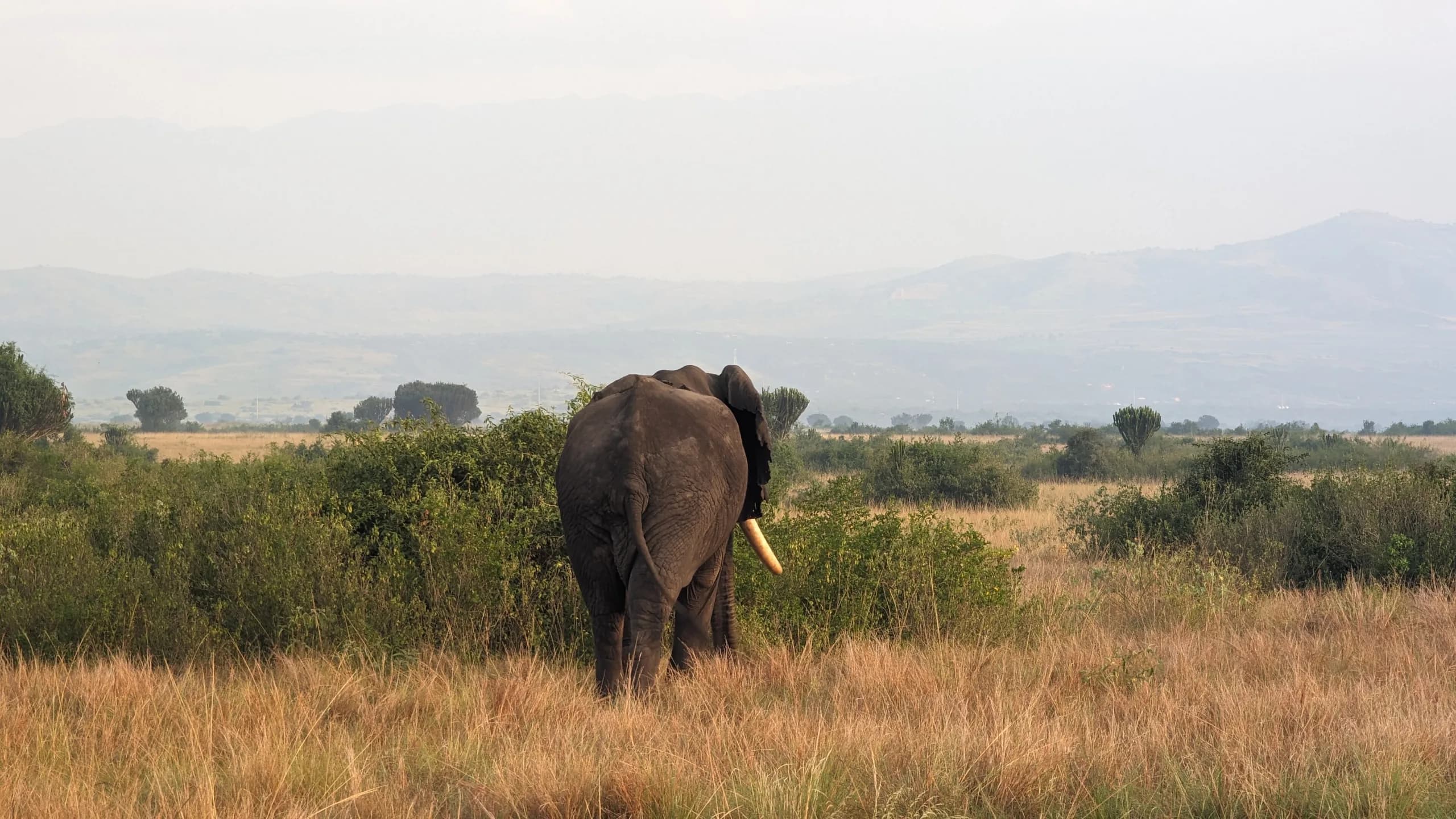
Yes, and it takes two habitats, usually two parks or two countries, roughly 10 to 14 days, and permits bought and paid for before the rest of the itinerary is fixed. Mountain gorillas live in a narrow band of montane forest in Uganda and Rwanda. The Big Five live on savannah, several hundred kilometres away.
Worth saying plainly: gorillas are not one of the Big Five. The five are buffalo, elephant, leopard, lion and rhino, a phrase inherited from hunting rather than ecology. So this is two trips stitched together, and the join is where the planning gets difficult.
Which routes actually work?
Four combinations do the job. Each trades cost against driving and border crossings.
| Route | Gorilla permit, foreign non-resident | Main savannah fees, foreign non-resident adult | The trade-off |
|---|
| Uganda only — Bwindi plus Queen Elizabeth or Murchison Falls, with a rhino stop |
USD 800, or USD 600 in April, May and November — UWA |
USD 40 per adult per 24 hours in the Category A parks, Queen Elizabeth among them; USD 45 at Murchison Falls — UWA |
One country, one visa, one operator. The most road time of the four. |
| Rwanda only — Volcanoes plus Akagera |
USD 1,500 — RDB, with a 30% low-season discount on the conditions below |
Akagera entry, international adult sleeping inside the park: USD 100 total for one night, USD 150 for two, USD 200 for three, then free to seven nights. Lodged outside you are a day visitor and pay USD 100 every day you enter |
Short transfers. The highest permit price, partly offset by that discount. |
| Uganda or Rwanda plus Kenya — gorillas, then the Masai Mara |
USD 800 or USD 600 (Uganda), or USD 1,500 (Rwanda) |
Masai Mara: USD 200 per person per day July to December, USD 100 January to June — Narok County |
Covered by one East Africa Tourist Visa. Needs a regional flight. |
| Uganda or Rwanda plus Tanzania — gorillas, then Serengeti and Ngorongoro |
USD 800 or USD 600, or USD 1,500 |
Serengeti USD 70 per day peak, USD 60 low, exclusive of 18% VAT — TANAPA. Ngorongoro USD 70.80 per person plus USD 295 per vehicle per crater descent — NCAA |
The most fees, and Tanzania sits outside the East Africa Tourist Visa. |
Two things the table cannot show. First, the Uganda gorilla permit already includes park entrance for the day you track, so Bwindi or Mgahinga entrance is not added on top of the USD 800 — the USD 40 line is for your other parks and other days. Second, some of these schedules have run past their printed dates. UWA's current booklet is the July 2024 to June 2026 edition, still the document UWA serves; the Mara rates are those of the Narok County Finance Act 2023, carried forward unchanged in the 2024 Finance Bill; and TANAPA's latest published tariff book is FY2023/2024, with no successor issued, so treat the Serengeti figures as indicative. We check every live figure when we quote.
Is it better to do it in one country or two?
One country is simpler and cheaper on flights and visas. Two countries usually gives better game viewing per day.
Uganda in one country. Gorillas are in Bwindi, in the far south-west; the savannah half is Queen Elizabeth or Murchison Falls. Rhino is the gap: completing the five here means a dedicated rhino stop, usually Ziwa Rhino Sanctuary — we confirm the current arrangements and fee when we quote. UWA's revised tariff structure taking effect on 1 January 2027 also lists rhino tracking at Ajai Wildlife Reserve, at USD 20 per adult. It is a long country crossing, which is why a Uganda circuit runs to nearly two weeks.
Rwanda in one country. Volcanoes National Park for gorillas, Akagera in the east for savannah. The permit is USD 1,500, but RDB publishes a 30% low-season discount, November to May, built to reward this combination: it requires a qualifying stay at Akagera and/or Nyungwe — either two nights at one park with a paid activity, or one night at Akagera and a consecutive night at Nyungwe with an activity — evidenced by a hotel confirmation of payment. It buys one discounted permit per three days and two nights of stay. Note that the Akagera taper applies only to visitors sleeping inside the park; lodged outside, you pay the day-visitor rate every day you enter.
Two countries. Gorillas in Uganda or Rwanda, then the Masai Mara, Serengeti or Ngorongoro. This is the version that puts big cats and open plains next to the forest, at the cost of a regional flight and a second set of park fees. Our Uganda and Rwanda combined and East Africa Grand Tour itineraries show both shapes. Undecided on the forest half? Our Uganda versus Rwanda comparison carries the airport-to-trailhead times: Kigali to Volcanoes is a short tarmac run, Entebbe to Bwindi most of a day by road.
How many days do you need?
The forest half is less flexible. A gorilla trek takes a full day: UWA puts Bwindi treks at between two and seven hours on the mountain, and describes moderate fitness as required. Volcanoes National Park reports at 07:00. You also need the day before to reach the trailhead, because nobody should arrive at a briefing off an overnight drive.
- Gorillas: three nights minimum, including travel in and out.
- A savannah park worth the airfare: three to four nights. Two nights is one full game-viewing day, which is thin for leopard and rhino.
- Realistic total: 10 to 14 days for a two-country combination; longer if you drive Uganda end to end.
Internal flights compress this. Drive times vary too much with road works and rain to tabulate, so we confirm sector times against your dates when we quote.
When should you go, and where do the seasons conflict?
This is the genuinely difficult part, because forest and savannah do not share a calendar and neither do the discounts.
June to August is the cleanest overlap. The long-term Bwindi record from the Institute of Tropical Forest Conservation shows June, July and August as the driest months in every year of its 13-year record — the single most stable feature of that dataset. Those months also fall inside the Serengeti–Mara dry season, which runs June to October. Everything is at full price.
April and May are the cheapest: UWA's low-season gorilla permit of USD 600 applies in April, May and November; the Masai Mara sits at its USD 100 low-season rate from January to June; and TANAPA's low-season Serengeti conservation fee of USD 60 runs 15 March to 15 May. These are also the MAM long rains across Uganda, Rwanda, Kenya and northern Tanzania, and the cheapest permit carries a hard condition: UWA states low-season permits cannot be rescheduled.
November gives you the USD 600 Uganda permit and falls inside Rwanda's November-to-May discount window, but the Mara is still on its USD 200 rate until the end of December.
Two further notes. Northern Uganda does not get the mid-year dry window the south enjoys — UNMA records that northern and parts of eastern Uganda usually receive substantial rainfall in June, July and August — which matters if Murchison or Kidepo is your savannah half. And nobody publishes Great Migration river-crossing dates. What is documented is that the Mara River is the herds' primary water source from August to October, and that GPS-collar data put the northward transition in a median window of 6 May to 29 June. Treat crossings as a pattern, never a schedule; our month-by-month guide sets out what can and cannot be predicted.
What has to be booked first, and in what order?
Permits, then flights, then lodges. Not the other way round.
- There is no free hold on Uganda permits. UWA suspended the seven-day reservation window with effect from 1 March 2026, so a permit is secured only on full payment at the time of booking. UWA accepts no deposits and no partial bank settlement. Our Uganda gorilla permit guide walks through that process.
- The two countries sell permits differently. UWA sells gorilla and chimpanzee permits to foreign non-residents only through Uganda Tourism Board licensed operators. RDB lets you book a Rwandan permit yourself — online through Irembo or the Visit Rwanda booking portal, or at an RDB Tourism Reservation and Sales office. In Rwanda it is international operators, not travellers, who must book through a Rwanda-based licensed operator.
- Only eight people per gorilla family per day in both countries. Rwanda's daily ceiling is 96 permits. Minimum age is 15 in both, and contact time is a maximum of one hour.
- Uganda permits are sold by date and entry point, not by gorilla family. Families are allocated on the morning of the trek, so an operator selling you a named family is selling you their expectation, not UWA's allocation.
- Rescheduling is limited, and limited differently in each country. UWA allows two reschedules per permit, the first free and the second attracting a 25% surcharge, with requests due at least 14 days ahead and new dates within 12 months — and low-season permits cannot be rescheduled at all. RDB allows a gorilla permit to be rescheduled once only, within 12 months of purchase and subject to availability.
The consequence for a combined trip: the gorilla date is the fixed point, and the savannah half moves around it.
What about visas across two countries?
The East Africa Tourist Visa costs USD 100, runs 90 days, and is multiple-entry across Kenya, Uganda and Rwanda — so it covers any gorilla-plus-Mara combination on one document. Your first entry must be through the country whose portal you applied on: Rwanda via Irembo, Uganda via visas.immigration.go.ug. An EATV bought through either one therefore commits you to landing there first, so if your trip starts in Nairobi, confirm the current route with Kenya Immigration before you build around it. Tanzania is not part of the arrangement, so a Serengeti leg needs Tanzania's own tourist visa at USD 50, or the USD 100 multiple-entry visa that US passport holders must use. Uganda also requires a yellow fever certificate from every visitor, submitted with the visa application itself; for anything else medical, speak to a travel clinic.
What should you expect, and what should you not?
Set expectations by species rather than by park. Elephant and buffalo are the dependable ones on any decent savannah, lion are common but never owed to you, and leopard and rhino are the two nobody can promise, in any country, on any budget. An operator who guarantees the full five is guessing on your behalf.
Three things that make the combination work in practice. Put the trek early in the trip, so a weather day or a reschedule does not collapse the itinerary. Check re-entry rules: an NCAA permit is valid for one entry within 24 hours, so an itinerary crossing Ngorongoro twice pays twice. And note that a Masai Mara ticket covers 06:00 to 18:00 and expires at 18:00 regardless of when you entered, under the Narok County Finance Act's own definition.
To have the trip costed properly, tell us your dates and which half matters more to you. Start with plan your safari, or browse gorilla trekking and Big Five safaris. Kenya: Mara and Amboseli pairs with either forest leg, and contact us if you would rather talk it through.