3 daysUganda
3-Day Bwindi Gorilla Short Break
Fly in to Kihihi, trek one family in Buhoma, fly out. The shortest honest gorilla trip.
From$2,950 per person
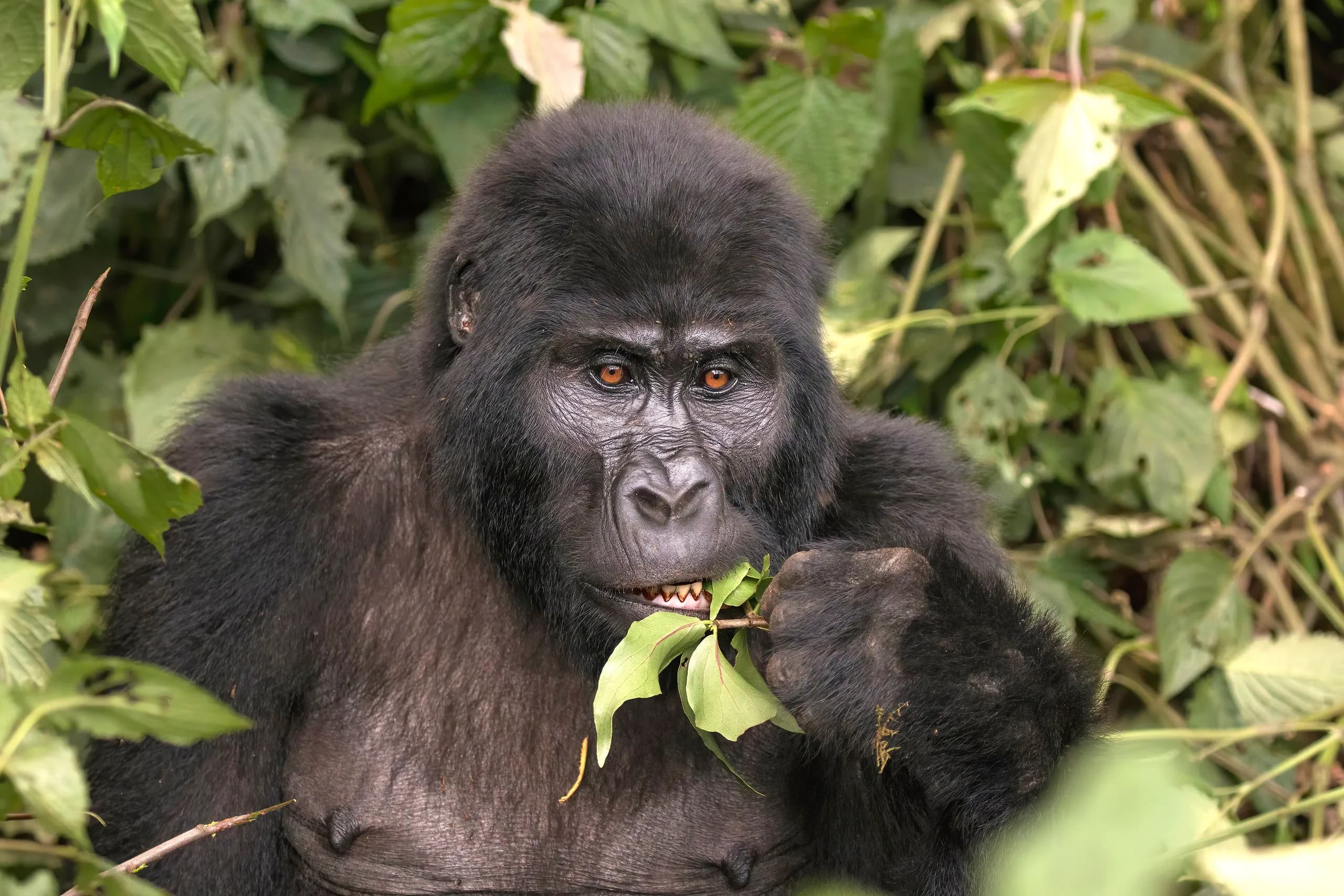
One hour with a mountain gorilla family, in Uganda or Rwanda
Mountain gorillas live in one place on earth: the forested volcanoes and ridges where Uganda, Rwanda and the Democratic Republic of Congo meet. Trekking them means buying a permit for a named date, walking into that forest behind a tracker, and spending exactly sixty minutes with a family that has been habituated to human presence over several years.
The walk is the variable. It can be forty minutes on a graded path or eight hours of steep, wet, tangled ground, and nobody knows which the night before, because the gorillas move and the trackers follow. The hour itself is fixed, timed and non-negotiable.
Uganda and Rwanda both do this well and they do it differently. Uganda is cheaper, the forest is denser, the walking is harder and the country holds more habituated families. Rwanda is more expensive, closer to an international airport and easier underfoot. Neither is the better trip in the abstract; one of them is the better trip for you.
A Uganda gorilla trekking permit is 800 US dollars per person for a foreign non-resident, set by the Uganda Wildlife Authority. A Rwanda permit is 1,500 US dollars per person, set by the Rwanda Development Board. Both figures cover park entry, the ranger guides, the trackers who located the family that morning, and one hour with the gorillas. Neither covers your lodge, your vehicle, your porter or your tips.
Uganda also sells a gorilla habituation experience in the Rushaga sector of Bwindi at 1,500 US dollars per person, rising to 1,800 on 1 January 2027 under a tariff revision confirmed in February 2026. That one puts four visitors, rather than eight, with a family still in the habituation process, for four hours rather than one. It is the right choice for photographers and researchers and the wrong choice for anyone who wants a shorter day.
Permits are issued against a specific date and a specific family. Book the permit first and build the itinerary around the date you are given, never the other way round. In June to September and December to February permits for the popular sectors are gone months ahead.
You report to the sector headquarters at around 07:30 for a briefing and are assigned to a group of eight. Trackers have usually been in the forest since first light and radio the family position back, so the walk is directed rather than exploratory. You carry water, rain shell, lunch and a camera. You leave the drone at home; they are banned in every park that offers this.
When the group reaches the family, bags go down, voices drop and the hour starts. Seven metres is the stated minimum distance, though gorillas do not read the rules and juveniles in particular will close it. Masks are required in some sectors and recommended in all of them, because we share enough of their respiratory biology to make a human head cold a serious matter for a silverback.
The minimum age is 15 in Uganda and Rwanda, and it is enforced with a passport check. Anyone with a cough, a fever or flu-like symptoms on the morning is refused and, in Uganda, refunded at the warden’s discretion rather than automatically.
You do not need to be an athlete, but you do need to be able to walk uphill on uneven ground for several hours at altitude. Where fitness is genuinely a limit, both countries run a sedan chair service, carried by teams from the surrounding villages, for a fee negotiated on the day. Arrange it in advance rather than at the trailhead.
Hire the porter. It is the best twenty dollars in the trip: they carry your bag, they physically haul you up the worst sections, and the fee is direct income to households on the park boundary, a number of whom are former poachers now earning more from live gorillas than they ever did from dead ones.
In Uganda, Bwindi Impenetrable Forest across its four sectors, and Mgahinga for the single Nyakagezi family. In Rwanda, Volcanoes National Park from the Kinigi headquarters. We do not currently send guests into the Congo side of the Virungas, and we will say plainly why if you ask.
Each of these already includes it. Any of them can be reshaped around your dates.
Tell us your dates and we will come back with an itinerary, the lodges we would use and a price that holds.