9 daysTanzania
9-Day Tanzania Northern Circuit
Baobabs and elephant at Tarangire, the crater floor at Ngorongoro, and three nights in the Serengeti
From$7,600 per person
A year-round circuit, not a single event, and it is only sometimes at a river
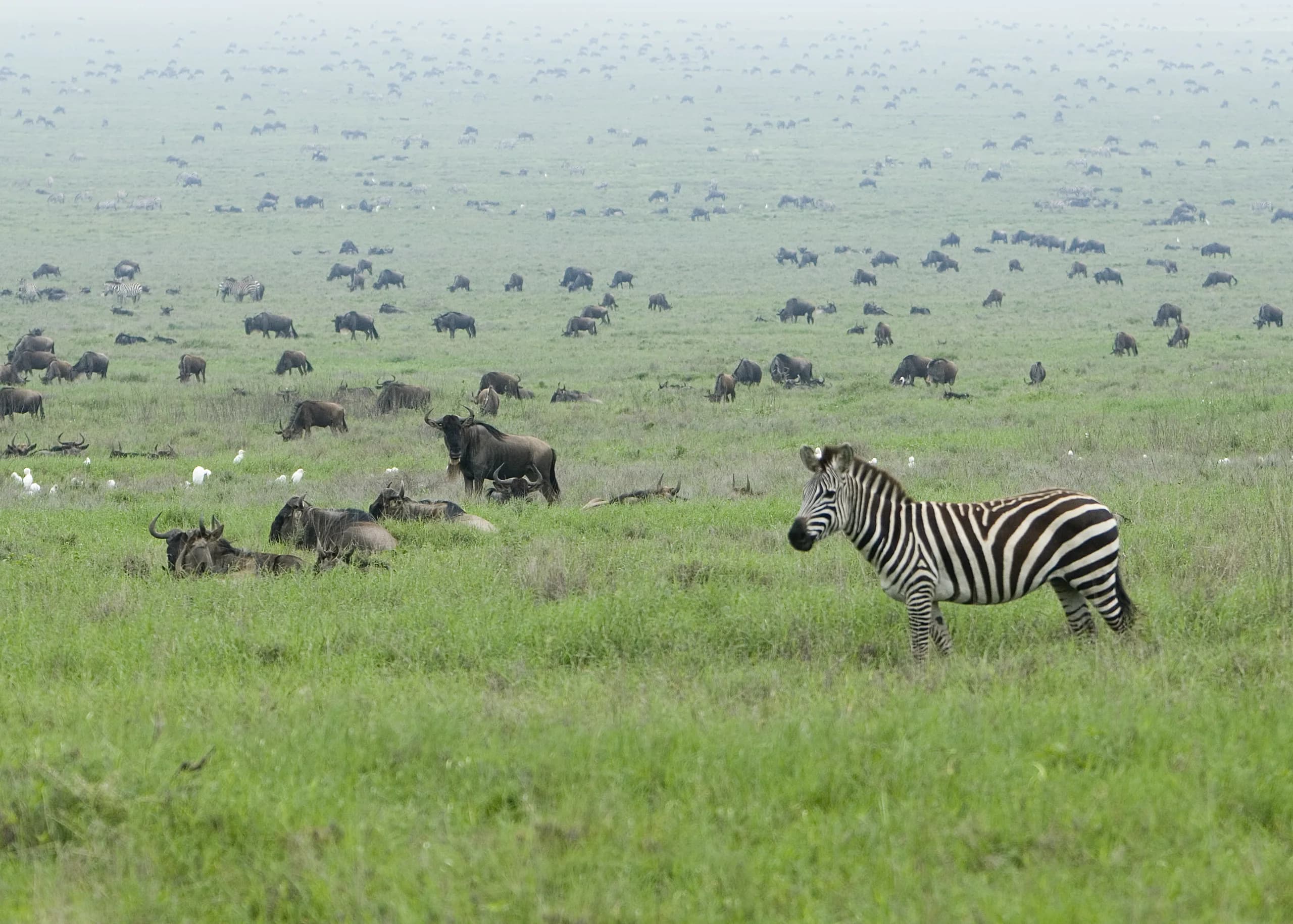
The great migration is roughly two million wildebeest, zebra and gazelle moving clockwise through the Serengeti and Masai Mara ecosystem in a continuous annual loop, following rainfall and grass. It never stops and it is never in one place. The only real question when planning is where the herds will be in the month you can travel, and which lodge that puts you in.
The river crossings that dominate the photographs are one part of the circuit, in the north, from roughly July to October. They are dramatic, they are unpredictable, and a herd can stand at the bank for six hours and then decide not to go. Building a whole trip around seeing one is how people come home disappointed.
The calving season in the southern Serengeti in February is, for many guides, the better trip. Hundreds of thousands of calves are born within a few weeks on open short-grass plains, every predator in the ecosystem is drawn to them, and the sightlines are far better than in the northern woodland.
| Months | Roughly where | What is happening |
|---|---|---|
| December to March | Southern Serengeti and Ndutu, Ngorongoro conservation area | Short-grass plains, calving peaking in February, heavy predator action |
| April to May | Central and western Serengeti | Long rains, herds moving north and west, lodges at their cheapest |
| June to July | Western corridor and the Grumeti river | Columns forming, Grumeti crossings, large crocodile |
| July to October | Northern Serengeti and the Masai Mara | Mara river crossings, both directions, entirely unpredictable |
| November | Moving south through the eastern Serengeti | Short rains pull the herds back down towards the plains |
Treat this as a pattern rather than a timetable. The herds follow rain, rain varies year to year, and a dry March can hold them south for weeks longer than the table suggests.
Be in the north between late July and early October, stay at least four nights, and accept that you will spend hours parked at a bank. Crossing points on the Mara river are known and your guide will position for one, but the herd decides. Groups that stay two nights and leave often see nothing; groups that stay five usually see at least one.
The Mara triangle on the Kenyan side and the Kogatende area of the northern Serengeti both work. The triangle has fewer vehicles than the Mara reserve’s eastern side. Whichever side you choose, a private conservancy alongside it gives you somewhere productive to be on the days the herds do not move.
Nobody can guarantee you a river crossing, and any operator who does is selling you something they do not control. What we can do is put you in the right part of the ecosystem for your dates, in a camp positioned for it, with enough nights to make it likely, and with a guide in radio contact with the vehicles already at the bank.
The camps that move with the herds are the ones worth booking. A mobile tented camp relocates two or three times a year to stay with the migration, which means it is genuinely in front of the animals rather than a two-hour drive from them. They are simpler than a permanent lodge, with bucket showers and no pool, and they are the better trip.
Each of these already includes it. Any of them can be reshaped around your dates.
Tell us your dates and we will come back with an itinerary, the lodges we would use and a price that holds.