A safari day is built around two windows of good light and one long gap in the middle. You are up before dawn, out on a game drive from first light through mid-morning, back for a late breakfast and several hours of rest, then out again in the late afternoon until the park closes. Trekking days work differently: one briefing, one walk, one hour with the animals.
Below is what fills each part, and the park rules that set the times, because on safari the clock is not really yours.
Why does a safari day start before dawn?
Two reasons, and only one of them is about wildlife.
The first is that animals move in the cool hours, and the light is low and warm rather than flat and white. By late morning most of what you want to see has found shade.
The second is administrative. Your park ticket is a timed product. In the Masai Mara, the county legislation that sets the fees defines an entry fee as covering entry from (6.00am - 6.00pm) time of entry notwithstanding — Narok County Finance Act 2023, section 2. That is a fixed daylight window, not twelve hours from your gate time: arrive at noon and the ticket still expires at 18:00. In Uganda, the Uganda Wildlife Authority's conservation tariff makes a day's park entrance valid for 24 hours from the time you enter, with extra time charged as another day. So a Ugandan safari day is measured from your gate time, while a Mara day is measured against the clock. We confirm both when we quote.
Either way, a 06:00 start buys you the whole of the good light. A 09:00 start throws half of it away.
What actually happens on a morning game drive?
Coffee and something small before you leave, usually taken standing up in the dark. Then out in an open or roof-hatched vehicle with a guide who is doing three jobs at once: driving, reading fresh tracks and droppings on the road, and listening to the radio for what other vehicles have found.
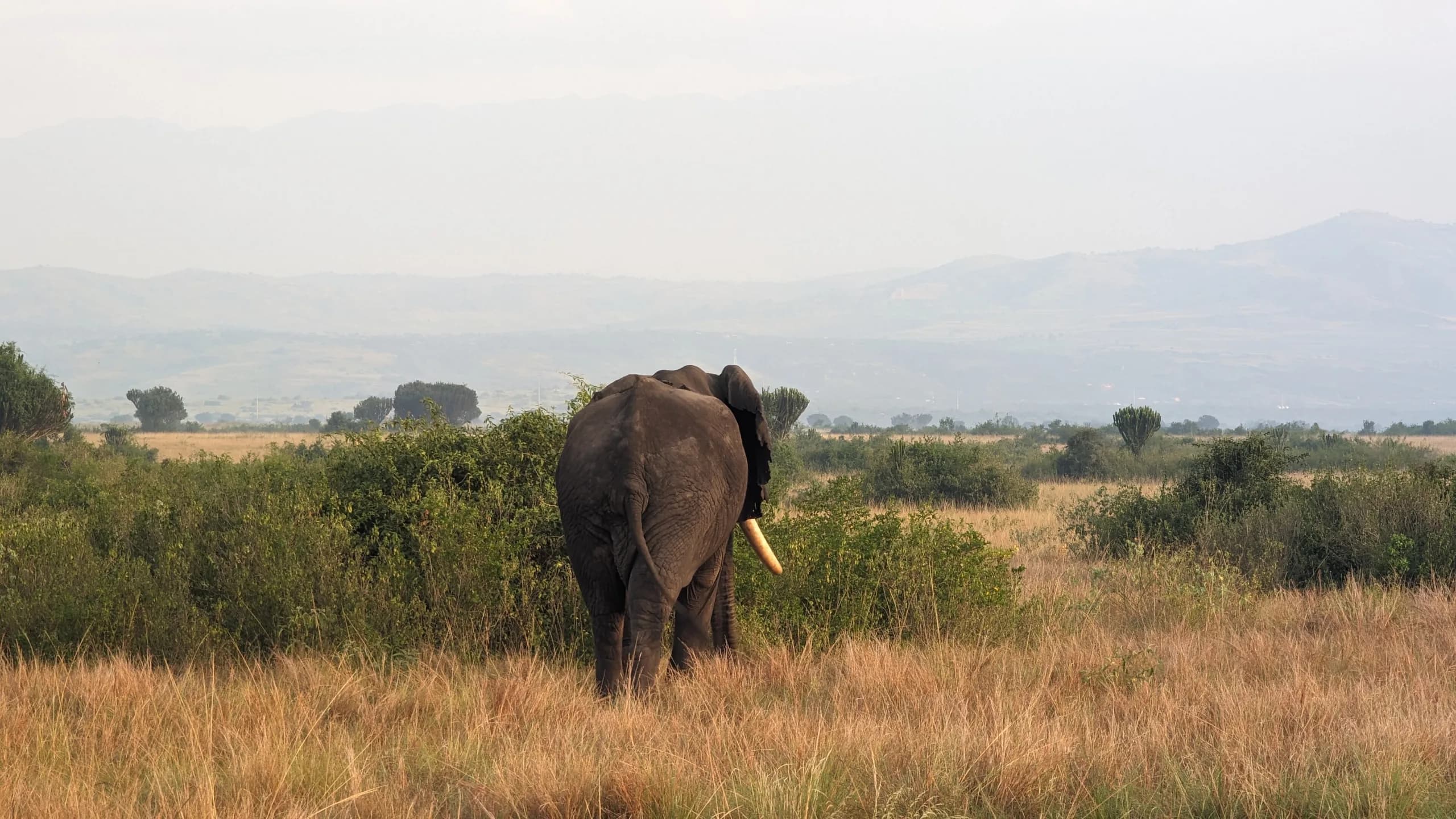
Most of a game drive is unremarkable in the best way — plains game, birds, the slow business of working a circuit. Then something happens, and you stop, and you might sit with it for forty minutes. There is no schedule inside the drive: the guide reads the ground, which is why the guide matters more than the itinerary on paper.
You come back mid-morning, hungry, dusty and usually quieter than you went out.
What do you do in the middle of the day?
Very little, and that is deliberate. The animals are resting, the light is unusable, and you have been awake since before five. A proper safari day includes a genuine gap: a long breakfast, then a few hours to sleep, read or go through the morning's photographs.
Where a midday activity makes sense, it is usually water-based. In Murchison Falls, Queen Elizabeth and Lake Mburo national parks, UWA runs launch trips of roughly two hours, priced at USD 30 per person for foreign non-residents. These are shared boats — UWA states the launch carries a maximum of 45 people in Murchison Falls and 40 in Queen Elizabeth — and departures are set by the park, not by you. UWA prices a small boat with a minimum charge of USD 120, and applies a party minimum of eight people for small boats in Murchison Falls and four at Lake Mburo, so the floor in Murchison is higher than the headline figure suggests. If you want a boat that is not shared, ask us to price it rather than working from the minimum. Those figures are from UWA's July 2024 – June 2026 conservation tariff, still the rates document UWA publishes, and we confirm them at quote stage.
The middle of the day is not dead time being sold to you as rest. It is the only part of the day the wildlife also takes off.
What is the afternoon drive like?
Out again in the middle of the afternoon, once the heat has broken. The drive tends to build rather than start well: quiet at first, then more active as the light drops and the temperature falls.
It ends when the park says it ends. In the Mara, that is the 18:00 edge of the ticket window. Elsewhere it is dictated by the park's own operating hours and by the practicalities of getting back on unlit tracks. Night drives are not available everywhere and are not ours to promise. We confirm what a given park permits at the time we quote.
How is a gorilla or chimpanzee trekking day different?
Completely. There is no morning-and-afternoon rhythm; there is one activity, and it takes as long as it takes.
In Uganda, UWA's July 2024 tracking guidelines set the start times: gorilla tracking from 8:00am, the gorilla habituation experience from 6:30am, chimpanzee tracking from 8:00am or 2:00pm, and chimpanzee habituation from 6:30am — with tracking time running from immediately after the briefing until you return for debriefing. UWA's own Kibale park page lists departures at 08:00, 11:00 and 14:00 from Kanyanchu. In Rwanda, RDB's 2018 booking guidelines put reporting time at Volcanoes National Park at 07:00 (09:00 for Karisimbi and the caves), with park offices operating 07:00 to 17:00.
Then you walk. UWA says treks in Bwindi may last between 2 and 7 hours and describes moderate fitness as required; Kibale chimpanzee treks run 2 to 5 hours. Whatever the walk in costs you, the time with the animals is fixed at a maximum of one hour on a normal trek, or four hours on a habituation experience. Group sizes are capped — a maximum of 8 visitors per gorilla family per day in both Uganda and Rwanda, and UWA states chimpanzee groups at Kanyanchu are capped at six.
One thing simplifies a Ugandan trekking day: the permit already carries the park entrance. UWA's tariff states that the gorilla tracking rate includes the guide fee, park entrance for the day and a community development contribution, and that the Kibale chimpanzee tracking and habituation rates include entrance too. Kyambura Gorge in Queen Elizabeth is the exception — that rate excludes park entrance, so a Kyambura day pays the gate as well.
A few rules shape the day. UWA requires a minimum distance of 10 metres from gorillas and chimpanzees, prohibits flash photography, and prohibits eating, drinking or smoking during the tracking — so drink on the walk in, not at the sighting. Anyone showing signs of illness before tracking is not permitted to go.
The overviews are at gorilla trekking and chimpanzee tracking.
How do the three kinds of day compare?
| | Savannah game-drive day | Uganda gorilla trekking day | Kibale chimpanzee day |
|---|
| What sets the start time | The light and the park's entry window — in the Masai Mara, a ticket covering 06:00 to 18:00 | UWA: tracking from 8:00am, or 6:30am for habituation | UWA guidelines: 8:00am or 2:00pm; UWA's Kibale page lists 08:00, 11:00 and 14:00 from Kanyanchu |
|---|
| How long you are out | A morning drive and an afternoon drive, with a long break between | UWA: treks in Bwindi may last between 2 and 7 hours | UWA: treks last 2 to 5 hours |
|---|
| Group size | Your own vehicle party | Maximum 8 visitors per gorilla family per day | UWA states groups capped at six |
|---|
| Time with the animals | As long as the sighting holds | Maximum one hour (four hours on habituation) | Maximum one hour (four hours on habituation) |
|---|
| Park entrance | Charged separately, per person per day | Included in the permit for the day of tracking | Included at Kibale; charged separately at Kyambura |
|---|
Does every day of a safari look the same?
No, and the differences are usually driven by how the park charges.
A Ngorongoro day is shaped by an NCAA permit valid for one entry within 24 hours only, and the crater service fee is charged per vehicle per descent at USD 295 for non-East African citizens. You descend once, so the day is built around a single entry rather than an in-and-out rhythm. NCAA warns that its tariffs are subject to change without prior notice, and publishes no effective date for the current one.
A Serengeti day is looser, because TANAPA states its conservation and vehicle fees allow multiple entry within the validity period. TANAPA's published tariff book is still the 2023/2024 edition with no successor since, so those figures are confirmed rather than assumed. The book states its charges exclude 18% VAT while TANAPA's website says fees are VAT-inclusive where applicable — a live 18% ambiguity, and another reason we confirm rather than publish it as settled.
Then there are transfer days. Not every day is a game-viewing day; some are mostly road, and on a circuit like the Uganda grand circuit that is unavoidable. We will tell you which days those are rather than dressing them up. Road times depend on the route, the season and the state of the surface, so we confirm them at quote stage rather than publishing a number that will be wrong half the time.
What do you actually need with you for the day?
Not much, but the right things.
- A warm layer, even in the dry months. The ITFC monitoring record at Ruhija in Bwindi (1987–1999) gives a mean daily maximum of 19C and a mean daily minimum of 14C, with recorded extremes of 11C to 24C — and June and July, two of the driest months, are also the coldest.
- Water you can drink before the sighting, given UWA's no eating or drinking rule during tracking.
- A camera you can work without flash, since flash photography is prohibited with gorillas and chimpanzees.
- Something for the vehicle — dust gets everywhere, and the morning is colder than you expect in an open vehicle at speed.
A fuller kit list is in what to pack for a gorilla trek.
Can you change the rhythm?
Within limits, yes. Permit start times and park entry windows are set by the authorities and are not negotiable. Almost everything else is.
On a private vehicle you can skip the afternoon drive and sleep, or stay out through the middle of the day with a packed lunch if a sighting justifies it. With children, shorter drives and a swap of the second one for time at camp usually works better — see family safaris. Photographing seriously means the opposite: earlier out, later back, longer at one sighting, which is the design principle behind photographic safaris.
That is the practical argument for a private vehicle: on a shared drive the day is a compromise between everyone else's preferences, and on a private one it is yours.
How we set the shape of your days
We build itineraries backwards from the fixed points — permit start times, park entry windows, the single Ngorongoro descent, the boat's departure — and then decide how much else the day can carry without becoming a forced march. A realistic day carries fewer things than a first draft suggests.
Tell us how you like to travel and we will tell you what your days will look like, with current fees and conditions confirmed at quote stage. Start at plan your safari, browse the routes under safaris, or get in touch.