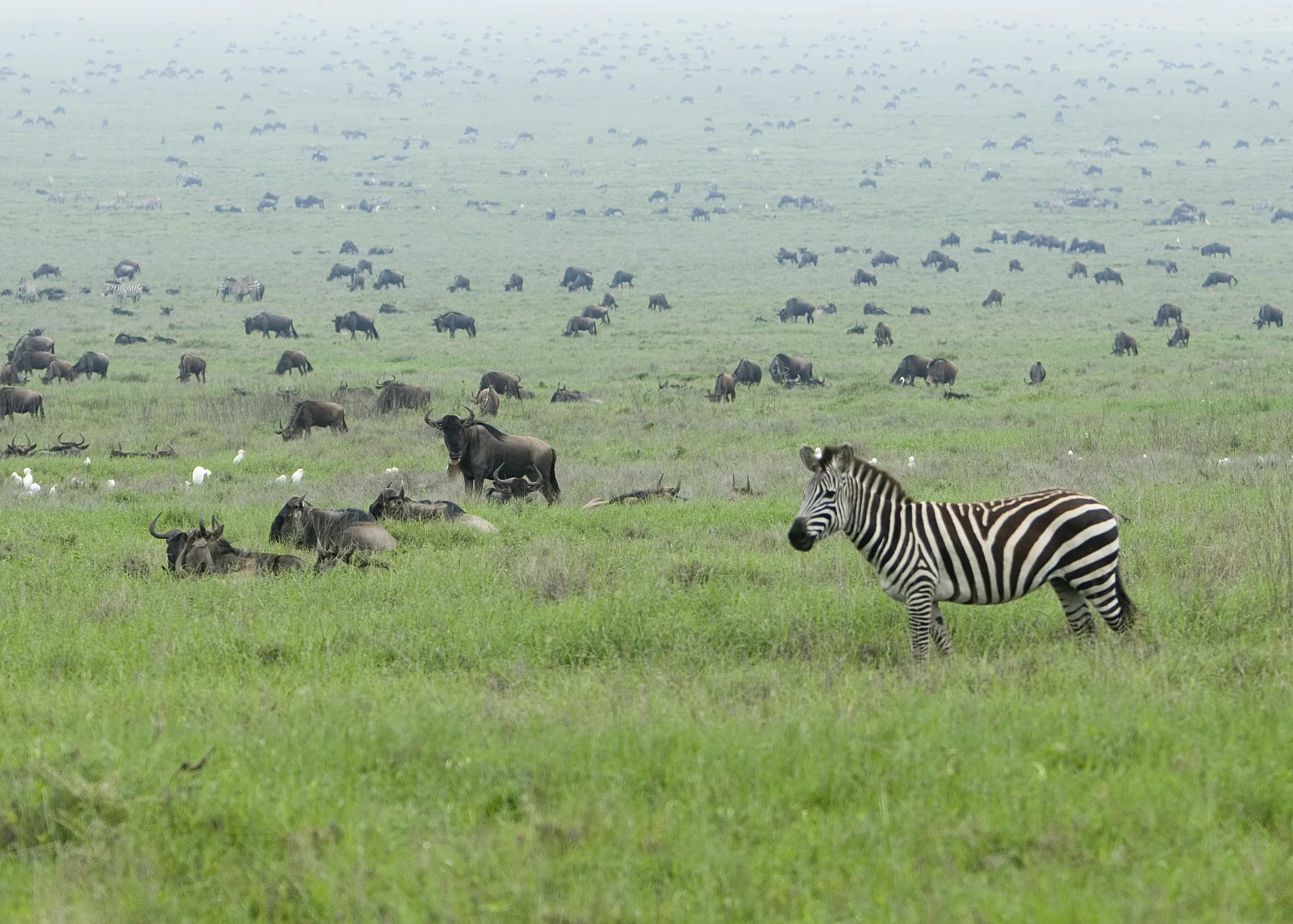
The great migration is a continuous clockwise loop, so the herds are always somewhere: on the southern Serengeti short-grass plains from December to March for the calving, moving north and west through April to July, in the northern Serengeti and Masai Mara from roughly July to October for the river crossings, and heading back south through November. There is no month in which the migration is not happening and no single place where it can be seen year round. Planning is therefore a matter of matching the month you can travel to the part of the ecosystem the herds will be in, and then booking a camp that is actually in that part rather than a two-hour drive from it. The two peaks most people choose between are the February calving in the south and the July to October crossings in the north.
Where are the herds in each month?
| Month | Roughly where | What is happening |
|---|
| December | Southern Serengeti, Ndutu, eastern plains | Herds settling onto short grass after the short rains |
|---|
| January | Ndutu and the Ngorongoro conservation area plains | Grazing, herds concentrating, first calves |
|---|
| February | Ndutu and the southern plains | Calving peak. Enormous predator activity on open ground |
|---|
| March | Southern and central Serengeti | Calves strengthening, herds beginning to drift north |
|---|
| April | Central Serengeti, moving west | Long rains. Green, quiet, cheapest month of the year |
|---|
| May | Central and western corridor | Columns forming and moving. The rut begins |
|---|
| June | Western corridor and the Grumeti river | Grumeti crossings, large crocodile, fewer vehicles |
|---|
| July | Northern Serengeti, first arrivals in the Mara | Mara river crossings begin, entirely unpredictable |
|---|
| August | Northern Serengeti and Masai Mara | Peak crossing period. Peak prices and peak vehicles |
|---|
| September | Masai Mara and northern Serengeti | Crossings continue in both directions |
|---|
| October | Mara, then moving south | Last crossings, herds beginning the return |
|---|
| November | Eastern Serengeti, moving south | Short rains pull them back down to the plains |
|---|
Treat this as a pattern, not a timetable. The herds follow rain, rain varies year to year, and a dry March can hold them in the south for weeks longer than the table implies.
How do I actually see a river crossing?
Be in the north between late July and early October, stay at least four nights, and be prepared to sit at a bank for hours. Crossing points on the Mara river are known, and your guide will position at one and wait. A herd can gather, mill about for six hours and then turn around and graze. Nobody controls this.
Groups who stay two nights frequently see nothing. Groups who stay five usually see at least one crossing. If a crossing is genuinely the point of your trip, buy the nights rather than the better room.
You can watch from either side. The Mara triangle on the Kenyan side of the river has fewer vehicles than the reserve east of the Mara river. The Kogatende area of the northern Serengeti is the Tanzanian equivalent. Both work.
Why do experienced guides prefer February?
- Hundreds of thousands of calves are born within a few weeks, in the open
- Short grass means you watch a hunt from the beginning rather than joining at the kill
- Cheetah are far easier to find and to photograph on the Ndutu plains than in northern woodland
- It is outside the northern high season, so camps are easier to book and cost less
- The action is reliable in a way a river crossing simply is not
The counterpoint is honest: calving season is not as photogenic as a crossing, and if the image in your head is wildebeest pouring down a bank into a river, February will not give you that.
Should I go to Tanzania or Kenya?
| | Serengeti, Tanzania | Masai Mara, Kenya |
|---|
| Migration months | Some part of the herd, most of the year | Roughly July to October |
|---|
| Calving season | Yes, Ndutu in February | No |
|---|
| River crossings | Mara river at Kogatende, Grumeti in June | Mara river, both directions |
|---|
| Scale | Very large. More driving, fewer vehicles per sighting | Compact. Shorter drives, more vehicles per sighting |
|---|
| Quiet alternatives | Move to a different sector | Private conservancies bordering the reserve |
|---|
| Pairs well with | Ngorongoro, Tarangire, Zanzibar | Amboseli, Lake Nakuru, the coast |
|---|
Which camps are worth booking?
Mobile tented camps, if the migration is your priority. These relocate two or three times a year to stay with the herds, which means they are genuinely in front of the animals rather than a long drive from them. They are simpler than a permanent lodge, with bucket showers and no pool, and for this particular trip they are the better choice.
A permanent lodge in central Seronera is comfortable and well placed for resident lion and leopard year round, but the migration is only there in a narrow window.
What should I not expect?
Nobody can guarantee a crossing. Any operator who does is selling something they do not control. What can be arranged is the right sector for your dates, a camp positioned for it, enough nights to make it likely, and a guide in radio contact with vehicles already at the river. That is the whole of what anyone can honestly promise.
The second thing not to expect is solitude in August in the Mara reserve. It is the single busiest wildlife event in Africa. If quiet matters to you, go in February, or go in the north of the Serengeti, or stay in a conservancy where vehicle numbers at a sighting are capped.