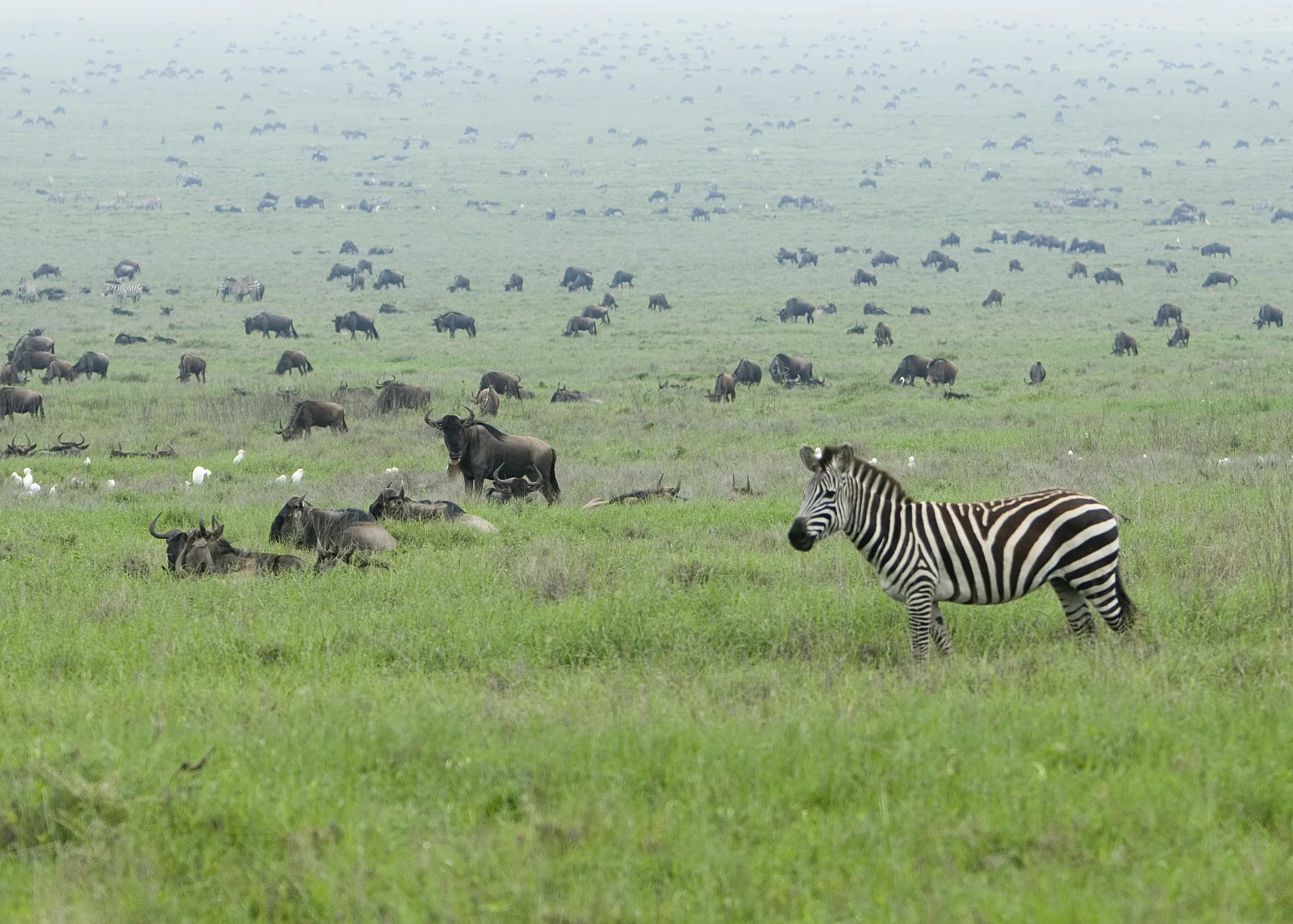
The Serengeti and the Masai Mara are the same ecosystem either side of the Kenya-Tanzania border, so the wildlife is broadly the same. Take the Mara for a short trip, simpler logistics and the August-to-October months when the herds depend on the Mara River. Take the Serengeti for scale, for the calving season on the southern plains, and for a longer, slower itinerary.
That is the short answer. The longer one is that most of the real differences are administrative rather than ecological, and they show up in your bill and your itinerary rather than in what you see from the vehicle.
What is actually different about them?
The wildlife is not the meaningful difference. The governance is.
The Serengeti is a national park managed by the Tanzania National Parks Authority (TANAPA), which publishes a national tariff book covering all its parks. The Masai Mara is not a Kenya Wildlife Service park at all. It is a National Reserve run by the Narok County Government, and its fees are set in county legislation - the Narok County Finance Act 2023 - rather than by KWS.
Three practical consequences follow:
- Ticket validity works differently. The Narok County Finance Act 2023 defines a Masai Mara park entry fee as covering entry "from (6.00am - 6.00pm) time of entry notwithstanding". Those last three words are operative: the ticket expires at 18:00 whatever time you drove in, so a late entry buys you less. TANAPA issues either a 12-daylight-hour permit or a 24-hour sleep-over permit, and states that its conservation and vehicle fees allow multiple entry within that validity period. The standard permit is therefore about twelve hours on both sides; what differs is the clock, since the Serengeti's runs as daylight hours with re-entry allowed while the Mara's is pinned to a day that ends at six.
- The land around the Mara behaves differently. The reserve is ringed by private conservancies whose fees are set commercially, per conservancy and per camp, and are normally bundled into the camp's nightly rate rather than itemised. No conservancy and no conservancies association publishes a rate card, so any figure you are quoted is camp-specific and worth getting in writing. That is a genuine second decision, and we cover it separately in reserve or conservancy.
- The Serengeti comes with a neighbour that bills separately. The Ngorongoro Conservation Area is administered by the NCAA, not TANAPA. Its entry permit for a non-East African adult is USD 70.80 per person, and the NCAA states that a permit "once issued is valid for one entry within 24 hours only". A crater descent carries a separate service fee of USD 295 per vehicle per trip. An itinerary that passes through Ngorongoro twice pays the entry permit twice, so route order matters financially in Tanzania in a way it does not in Kenya.
Which one gives you the better shot at the migration?
Neither owns it. The Convention on the Conservation of Migratory Species (CMS) describes roughly 1,300,000 migratory wildebeest moving on a rainfall-driven cycle across the whole ecosystem, and the closest thing to a timetable that exists - GPS collar data from 62 animals tracked between 1999 and 2022 - resolves into multi-week transition windows rather than dates. Those windows are set out month by month in the migration month by month, from the Tanzanian side in when to visit Tanzania and from the Kenyan side in when to visit Kenya.
For the choice between these two parks, two windows do the work:
- Calving, in the Serengeti. Peer-reviewed work published in Scientific Reports records nearly 500,000 calves born within roughly a three-week period. BBC Wildlife Magazine places that window between January and March, with roughly 80 to 90 per cent of calves born inside it, February the peak month, and as many as 8,000 calves in a single day, on the short-grass plains of the Ndutu area in the southern Serengeti and the adjoining Ngorongoro Conservation Area. No authority publishes a calving month: CMS says only that females calve at the peak of the rainy season.
- Mara River dependence, in Kenya. CMS states that the Mara River is the herds' primary water source from August to October, and the only permanently flowing river in the ecosystem. Rains generally return by November and the wildebeest move south again.
What no one publishes is river-crossing dates. No government agency, park authority or research body issues them, and the crossings are not tracked as discrete events. Anyone selling you a crossing on a specific date is selling you a guess. CMS also notes that discharge meters have recorded the first-ever instances of no-flow in the Mara River within the last seven years, and that these are becoming more frequent and longer. We build around the pattern rather than around dates on our Great Migration itineraries.
What do the two governments actually charge?
Both authorities revise fees on their own schedule and without notice, so treat the table as structure rather than as a live quote.
| Charge | Masai Mara (Narok County) | Serengeti (TANAPA) |
|---|
| Who sets it | Narok County Government, Finance Act 2023 | Tanzania National Parks Authority tariff book |
| Non-resident adult, per person per day | USD 200 in high season (July to December); USD 100 in low season (January to June) | USD 70 in peak season (16 May to 14 March); USD 60 in low season (15 March to 15 May) |
| VAT | We have found no VAT statement in the county schedule - confirm with the reserve | The tariff book states all charges are VAT (18%) exclusive, so USD 70 becomes USD 82.60; the TANAPA website tariff page says the opposite |
| Children | Ages 9 to 17: USD 50 per day. Age 8 and under: free | Ages 5 to 15: USD 20 per day. Under 5: free |
| Ticket window | 06:00 to 18:00, time of entry notwithstanding | 12-daylight-hour permit or 24-hour sleep-over permit, multiple entry within the period |
| Vehicle | KES 1,000 under 6 seats; KES 1,500 for 6 to 12; KES 3,500 for 13 to 24; KES 4,500 for 25 to 44, per vehicle per day | Charged separately and, like the conservation fee, allowing multiple entry within the permit period |
| Bed night surcharge | No bed-night charge appears in the fee schedule we can cite; conservancy and camp charges are separate and set commercially | Hotel concession fee: USD 60 per person per night July to September, USD 50 October to June, itemised on the lodge invoice |
Two traps sit in that table. First, TANAPA runs the conservation fee and the concession fee on different season windows - peak conservation runs 16 May to 14 March, while peak concession is July to September only. That mismatch is a common source of quoting errors. Second, the comparison flips with the season: in the Kenyan high season the Serengeti is cheaper per person per day even with VAT and the concession fee added, while from January to June the Mara's USD 100 undercuts the Serengeti's stacked total.
One caveat, stated rather than hidden. The latest tariff book TANAPA publishes is the 2023/2024 edition, and the latest primary Narok County document setting Mara fees is the Finance Act 2023, with the 2024 Finance Bill proposing no change. Neither authority has published a newer schedule we can cite. The NCAA figures are weaker still: its tariffs page carries no effective date, no validity period and no VAT statement, so USD 70.80 and USD 295 are as-accessed numbers rather than as-of a stated schedule. TANAPA also contradicts itself on VAT - the tariff book says charges are exclusive of 18% VAT, the website tariff page says fees are inclusive - and every stacked total above turns on which document is right. We treat the tariff book as authoritative and check the current figures with the authorities before confirming a quote.
Which suits a short trip, and which rewards a long one?
The Mara is a single reserve, compact enough to work on a short itinerary - which is why it pairs so naturally with Amboseli on a short Kenyan circuit.
The Serengeti is not really one place. The southern short-grass plains, the Western Corridor and the north behave as different destinations in different months - CMS describes the herds retreating to the Western Corridor in June and July for sodium-rich grasses before moving further north once seasonal rivers run dry. Getting value out of that means moving between camps rather than basing in one, and it means the northern circuit rather than a single-park stay. Four nights favours the Mara. Ten favours the Serengeti.
Underlying both: the peer-reviewed literature puts the Serengeti-Mara ecosystem's wet season at November to May and its dry season at June to October. That applies on both sides of the border.
Can you do both in one trip?
Yes - see Kenya and Tanzania combined. The complication is paperwork rather than distance.
- The East Africa Tourist Visa covers Kenya, Uganda and Rwanda only, at USD 100 for 90 days multiple entry within those three countries. Tanzania is not part of it despite being an EAC member, and an EATV gives you no entry rights to the Serengeti, Ngorongoro or Zanzibar.
- Tanzania is applied for separately through its own eVisa portal. The ordinary single-entry tourist visa costs USD 50 for stays of up to 90 days. US passport holders cannot use it - Tanzania Immigration requires them to take the Multiple Entry Visa at USD 100, valid one year, and states they cannot obtain it on arrival.
- Kenya's eTA replaced its visas, and neither is issued on arrival. The official eTA FAQ puts standard processing at a fee starting at USD 30, with optional expedited processing at an additional USD 100. Holders of an East Africa Tourist Visa issued by a member country are exempt from the eTA.
More on all of that in the East Africa Tourist Visa explained.
Does travelling with children change the answer?
Slightly, and in the Serengeti's favour on fees. TANAPA charges non-East African children aged 5 to 15 USD 20 per person per day, with under-fives free. Narok County charges USD 50 per day for children aged 9 to 17, with children of 8 and under admitted free. On a family of four staying a week, that difference is not trivial. Everything else - vehicle configuration, camp suitability, drive lengths - is a property-by-property question we work through when planning family safaris.
So which should you book?
- Short trip, first safari, or Kenya already on the route: Masai Mara.
- January to March, and calving is the priority: southern Serengeti, Ndutu area.
- August to October, and the Mara River is the priority: Masai Mara, or the northern Serengeti on the same river.
- Ten nights or more, and you want variety within one country: Serengeti, on the northern circuit with Ngorongoro.
- Travelling January to June on a tight budget: the Mara's USD 100 beats the Serengeti once the hotel concession fee is stacked on top, though the Serengeti conservation fee alone is lower.
- Fixed dates and you want the best odds: tell us the dates first. We will say which park the dates favour rather than which park we would rather sell.
If you already know your dates, send them to us and we will come back with the honest version - including where neither park suits those dates well. Or just ask us a question first.