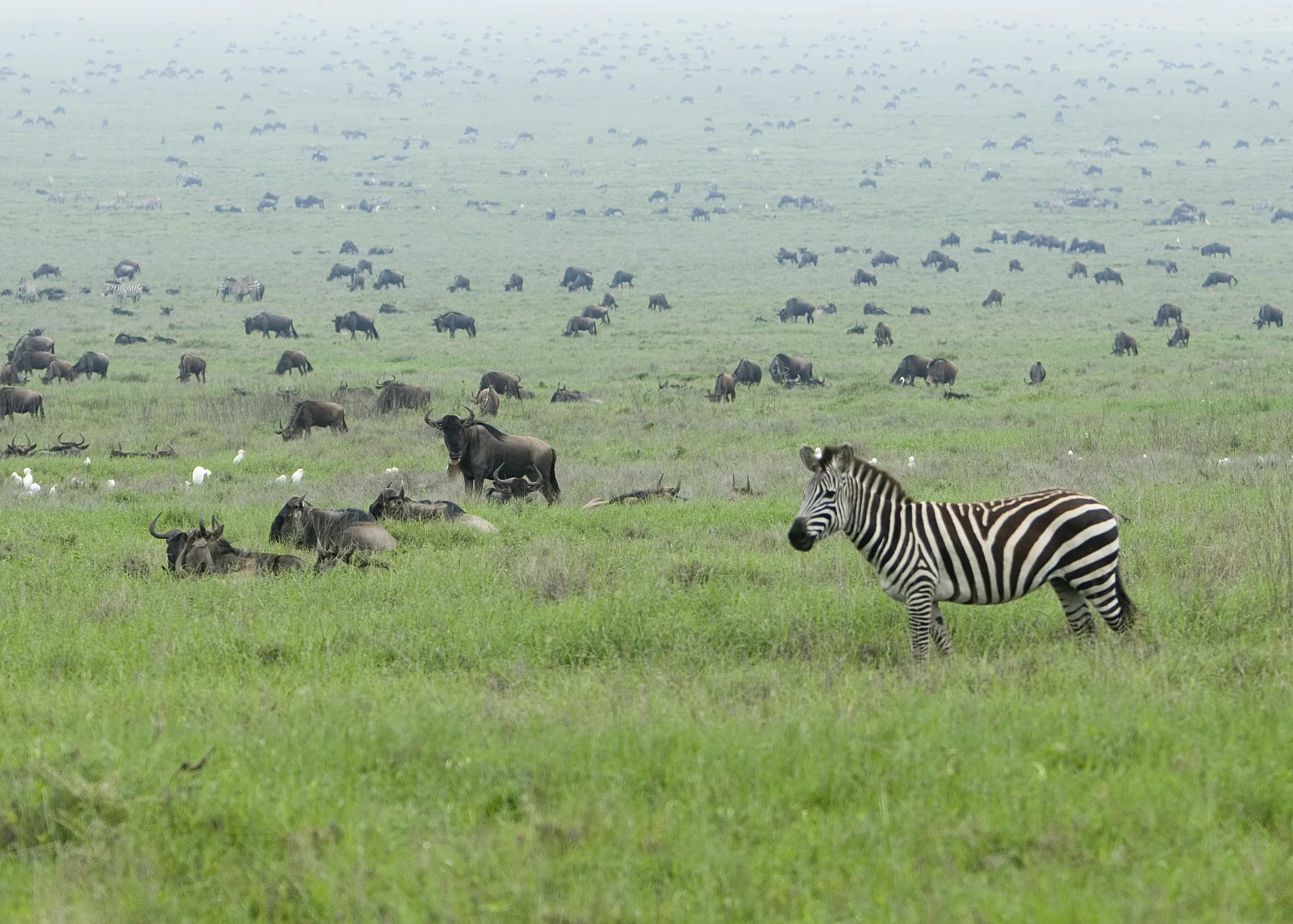
Tanzania, for most of the year. On the migration's documented annual sequence the herds are inside the Serengeti from calving on the southern short-grass plains, through the Western Corridor in June and July, until they push north. Kenya's Masai Mara comes into its own from roughly August to October, when the Mara River is the herds' primary water source. Same animals, same ecosystem — the border changes your fees and your visa, not the wildebeest.
The Convention on the Conservation of Migratory Species (CMS) describes the Serengeti–Mara population as roughly 1,300,000 migratory wildebeest and states plainly that seasonal rainfall drives the migration. There is no route map and no fixed annual schedule. GPS-collar data from 62 animals tracked between 1999 and 2022 put individual route lengths between 44.3 km and 224.7 km, mean 131.9 km — so "where the herds are" is a broad front rather than a point on a map.
What the border does change is real and expensive: which authority sets your park fee, what that fee is, how long your ticket lasts, and which visa you need. Our Great Migration page sets out how we build around them.
When are the herds on the Tanzanian side?
The CMS account of the year runs like this: females calve on the southern short-grass plains at the peak of the rainy season; with the dry season's onset in May they move westwards; they retreat to the Western Corridor in June and July for sodium-rich grasses; then they move further north once the seasonal rivers run dry. The collar data give a median northward transition window of 6 May to 29 June, averaging 38 days — a multi-week movement, not a departure date.
Calving is the one genuinely bookable event in the cycle, though no park authority publishes a calving month and CMS itself says only that it happens at the peak of the rainy season. Reported figures put roughly 80–90% of calves in a narrow three-week window somewhere between January and March, February the peak month, with as many as 8,000 born in a single day at the height of it on the short-grass plains of the Ndutu region in the southern Serengeti and the adjoining Ngorongoro Conservation Area. Peer-reviewed work in Scientific Reports puts it at nearly 500,000 calves in about three weeks, with measured calving synchrony of 19.6 to 29 days across years and herds. Predators concentrate accordingly.
If someone in your party wants a spectacle they can plan a trip around, calving is the honest answer — far more reliable than any river crossing.
When are the herds on the Kenyan side?
CMS states that the Mara River serves as the herds' primary water source from August to October, and that it is the only permanently flowing river in the ecosystem. Rains generally return by November and the wildebeest migrate south again — the collar-derived southward transition has a median window of 10 October to 2 November, averaging 41 days.
That window is the basis of Kenya's reputation for the migration, and it is sound. But two things need saying straight. First, no government agency, park authority or research body publishes river-crossing dates. Crossings are not tracked as discrete events at all. Any operator who sells you a crossing on a named week is selling you their own expectation, not a schedule. Second, the river itself has become less reliable: discharge meters have recorded the first-ever instances of no-flow in the Mara River within the last seven years, and these are becoming more frequent and longer.
Note too what the permanent-flow line implies. The Mara is the only river the herds can depend on through the dry months, and they work it from both countries — so August to October is a season you can plan from either side of the border.
How do the two compare on the things you actually pay for?
| Line item | Masai Mara, Kenya | Serengeti, Tanzania |
|---|
| Fee-setting authority | Narok County Government (not KWS) | TANAPA; NCAA sets Ngorongoro separately |
| Non-resident adult entry | USD 200 per day July–December; USD 100 per day January–June | USD 70 per day peak (16 May–14 March); USD 60 low (15 March–15 May) |
| VAT | Not addressed in the fee schedules we can source | Tariff book says charges are VAT (18%) exclusive; TANAPA's website says fees are VAT inclusive |
| Children | Ages 9–17 USD 50 per day; 8 and under free | Ages 5–15 USD 20 per day; under 5 free |
| Ticket validity | Fixed 06:00–18:00, "time of entry notwithstanding" | Conservation and vehicle fees allow multiple entry within validity |
| Extra line on the lodge bill | Vehicle charge: KES 1,000 under 6 seats, KES 1,500 for 6–12 seats, per day | Hotel concession fee: USD 60 per person per night July–September, USD 50 October–June |
| Herds present | Mara River is the herds' primary water source August to October (CMS) | Calving January–March, Western Corridor June–July, north thereafter |
| Visa route | eTA, or the East Africa Tourist Visa if combining with Uganda or Rwanda | Separate Tanzanian eVisa; the EATV does not apply |
How much do the park fees really differ?
Considerably, and in a way that compounds over a week. Under the Narok County Finance Act 2023, the Masai Mara non-resident adult rate is USD 200 per person per day in high season (July–December) and USD 100 in low season (January–June). Note where the line falls: the fee doubles across the whole second half of the year, which covers every month the herds are there. The Act's interpretation section defines the ticket as covering entry "from (6.00am – 6.00pm) time of entry notwithstanding" — so it expires at 18:00 whatever time you drove in, not twelve hours from entry.
Tanzania's headline number is lower but arrives in more pieces. TANAPA's published tariff puts the Serengeti conservation fee at USD 70 per non-East African adult per day in peak season and USD 60 in the narrow 15 March to 15 May low window. The same tariff book states that all charges are VAT (18%) exclusive, which would put the cash cost at USD 82.60 and USD 70.80 — but TANAPA's own website tariff page says fees are inclusive of 18% VAT where applicable. The two contradict each other, so treat USD 82.60 as the prudent planning figure and confirm it before it enters a quote. On top sits the hotel concession fee, USD 60 per person per night in July–September and USD 50 the rest of the year, itemised on your camp invoice. TANAPA's concession season and its conservation-fee season use different date ranges, a common source of quoting errors.
A northern-circuit trip usually adds Ngorongoro, administered separately by the NCAA: USD 70.80 per non-East African adult, a motor vehicle permit of USD 47.20 for a standard safari vehicle up to 2,000 kg, and a crater service fee of USD 295 per vehicle per descent. Permits are valid for one entry within 24 hours, so an itinerary that transits twice pays twice.
Two honesty notes. TANAPA still publishes only its 2023/2024 tariff book, and the latest Narok County fee documents we can source are the Finance Act 2023 and the Finance Bill 2024, which proposed no change. Neither authority publishes a revision calendar, and the NCAA warns outright that its tariffs are subject to change without prior notice — so we confirm all three schedules directly before a figure goes into a quote. Mara conservancy fees are a separate matter again — no conservancy publishes a rate card, so we cover them in reserve or conservancy rather than quoting a number here.
Which country is simpler to enter?
Kenya, if you are combining with Uganda or Rwanda. The East Africa Tourist Visa costs USD 100, runs 90 days multiple-entry, and covers Kenya, Uganda and Rwanda only. Tanzania is not part of the arrangement despite being an East African Community member, so an EATV gives you no entry rights to the Serengeti, Ngorongoro, Kilimanjaro or Zanzibar — Tanzania is applied for separately through its own eVisa portal at USD 50 single entry, or the USD 100 one-year multiple-entry visa US passport holders must take instead.
Two rules then decide the paperwork. The EATV must be used to enter the bloc through the country whose portal issued it — apply via Rwanda and you land in Rwanda first — and Rwanda and Uganda are the only issuing routes that can be confirmed, since no current Kenyan government page shows Kenya still selling it. Kenya otherwise requires an Electronic Travel Authorisation rather than a visa, USD 30 for standard processing with an optional expedited service at an additional USD 100, though nationals of almost all African countries are exempt from it under Legal Notice No. 93 of 30 May 2025, Somalia and Libya excepted, as are EATV holders. Give us your nationality and routing at plan your safari and we will confirm which applies.
Should you just do both?
Between August and October, often yes — the herds are working one river system and a crossing does not care which flag flies over the bank. A combined itinerary buys you two shots at the same event under different weather and vehicle pressure, which is what our Kenya and Tanzania migration route is built for. Budget for two immigration processes and two sets of park fees; they do not net off.
Outside that window the case for both is weaker. In January and February, Tanzania alone is the stronger trip and the northern circuit gives you calving plus Ngorongoro. In the low-fee half of the Kenyan year the Mara is excellent for resident predators and general game rather than migration, and pairs with Amboseli on our Mara and Amboseli route.
So which should you book?
- Choose Tanzania if you are travelling November to July, if calving is what you want, or if you want the lower headline conservation fee and the longer season of herd presence. Be clear what that headline covers: once TANAPA's hotel concession fee is added, a January-to-June Serengeti day comes to roughly USD 132.60 per person against the Mara's USD 100 low-season rate, so on government charges Tanzania is the dearer country for those months.
- Choose Kenya if you are travelling August to October, if you are combining with Uganda or Rwanda on one visa, or if a shorter flight-and-transfer chain matters more to you than the daily fee.
- Choose both if you are travelling August to October and have the days for it. That is a house judgement rather than a rule, but we would not sell a two-country migration trip under about ten days.
- Choose on the herds alone at your peril. Timing shifts measurably with rainfall in both directions: an unusually wet season lengthens occupancy of the southern plains and delays the move north, while drought brings it forward.
The figures above come from the authorities that set them — Narok County, TANAPA, NCAA and the immigration departments — and each revises on its own schedule, so we check every one against the current published schedule before we quote you, and we tell you which line on the invoice is a government fee and which is ours. Tell us the month you can travel; it decides this question more than any preference does. For the movement laid out through the year, read the migration month by month.