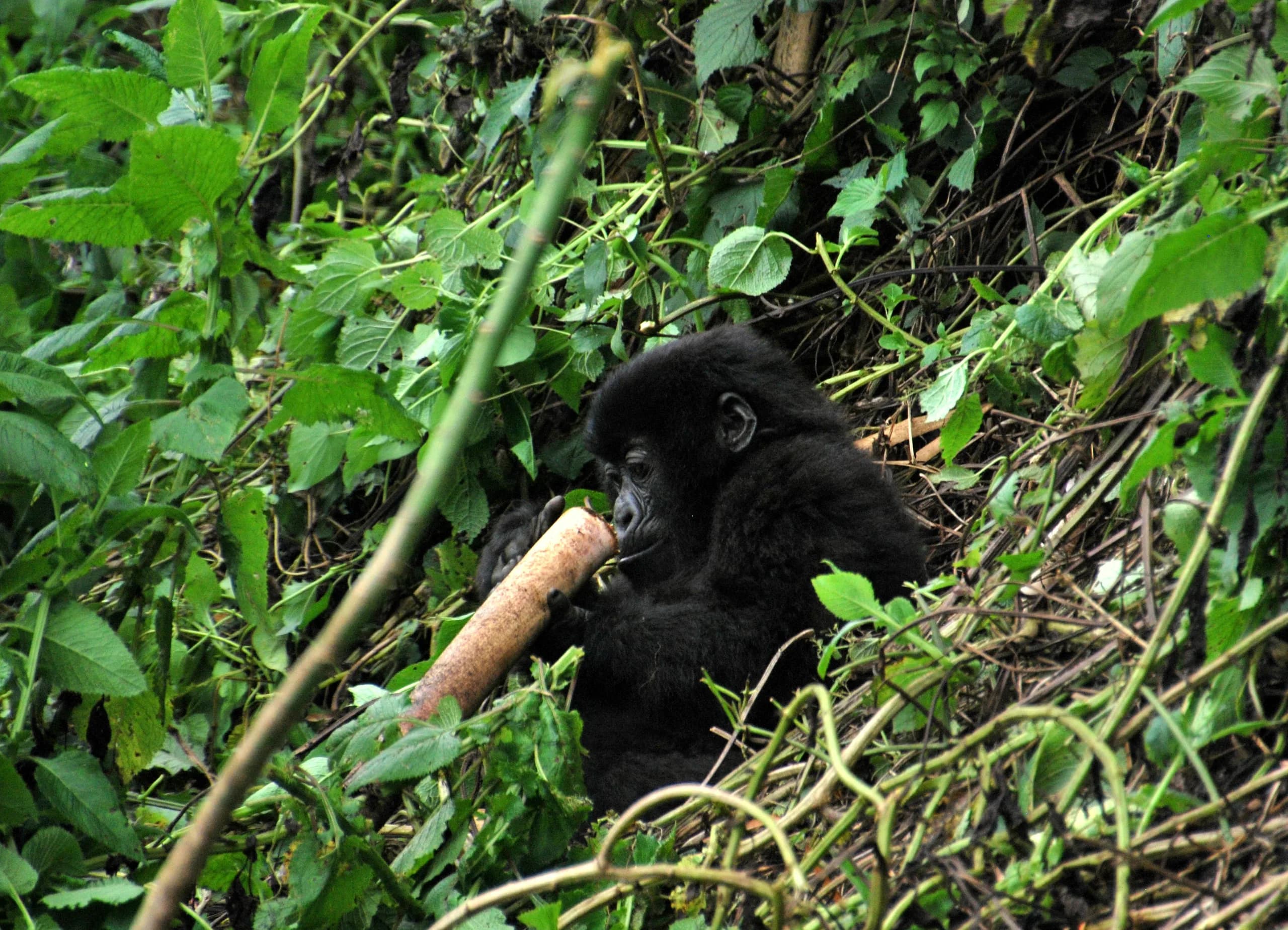
The minimum age for gorilla trekking is 15, in Uganda and in Rwanda alike. It is a permit condition set by the Uganda Wildlife Authority and the Rwanda Development Board, not something a guide can waive on the morning. Uganda's chimpanzee minimum is less settled than it looks: UWA's 2024 tracking guidelines set 12, while UWA's own Kibale National Park page states a minimum age of 16. If your child is under age, you wait, you split the trek between parents, or you build the trip around them.
What exactly does the 15-year rule say?
In Uganda, the rule sits in section 6 of the Uganda Wildlife Authority's Guidelines for the Management of Gorilla and Chimpanzee Tracking, approved by the UWA Board in March 2024 and signed by the Executive Director in July 2024. It sets 15 years as the minimum age for gorilla tracking and 12 years for chimpanzee tracking.
In Rwanda, the Rwanda Development Board's permit and reservation guidelines set a minimum of 15 years for mountain gorilla and chimpanzee tracking, and for Musanze Caves, Karisimbi, Bisoke, Muhabura, Gahinga and the Congo Nile Divide trail. RDB's own tourism site repeats the figure of 15 on its gorilla tracking page.
Both authorities revise their rules and rates on their own schedule, so the sensible thing is to have your operator confirm the current position at the point of quoting. But the gorilla number has been stable, and neither authority publishes an exception for a tall, fit or well-travelled fourteen-year-old.
Why is the minimum age 15?
Neither UWA nor RDB publishes a stated reason. What UWA does publish, in the same documents, is the set of rules a trekker has to hold to, and they explain the age limit better than any rationale would.
- You must stay at least 10 metres from the gorillas at all times, and the same distance from chimpanzees.
- Time with the gorillas is capped at one hour, measured from the moment you reach them.
- No eating, drinking or smoking during the tracking, and no flash photography.
- If you must cough or sneeze, you cover your face and turn away. UWA states plainly that gorillas catch coughs and colds from humans, and anyone with a cold or other infectious illness is not to visit them at all.
- A trek in Bwindi may last between two and seven hours, and UWA describes moderate fitness as a requirement.
Read together, that is an hour of quiet self-control at the end of what can be most of a day's walking, in a situation where a human respiratory infection is a genuine risk to the animals. Fifteen is where the two authorities have drawn the line. You also cannot engineer an easier day for a younger trekker: permits are sold by date and by entry point, not by gorilla family, and visitors are allocated to a specific group only on the morning of the trek.
Is there any way around the age limit?
No, and you should be wary of anyone who implies otherwise. Foreign non-residents cannot buy a Uganda gorilla or chimpanzee permit directly at all. UWA sells them only to tour operators licensed by the Uganda Tourism Board, which means an operator has to put your child's details on that permit. We will not do it, and a licensed operator that would is one you should not be booking with.
The checks are real. Clients' bio data has to be on the permit before the tracking date, and permits are validated against UWA records at the entry point. UWA treats a visitor booked under one category who appears in another as attempted fraud, with the operator and the visitor both held liable, and it states that anyone tracking without an authentic permit is liable to arrest and prosecution. This is not a system with a soft edge.
What are the minimum ages for the other primate treks?
The chimpanzee answer in Uganda is the one to be careful with, because UWA's own sources disagree. Section 6 of the 2024 guidelines sets the minimum at 12. UWA's live Kibale National Park page, the same page that gives the Kanyanchu departure times and the six-person group cap, states a minimum age of 16. Both are UWA publications, and neither one acknowledges the other, so a family should not build an itinerary around the lower figure: we confirm the age with UWA reservations before booking any trekker under 16. Rwanda has no equivalent step down at all.
| Activity | Authority | Minimum age |
|---|
| Mountain gorilla trekking, Uganda (Bwindi, Mgahinga) | UWA | 15 |
| Mountain gorilla trekking, Rwanda (Volcanoes) | RDB | 15 |
| Chimpanzee tracking, Uganda (Kibale, Kyambura) | UWA | 12 in the 2024 guidelines, 16 on UWA's Kibale park page — confirm before booking |
| Chimpanzee tracking, Rwanda (Nyungwe) | RDB / Nyungwe Management Company | 15 |
| Bisoke, Karisimbi, Dian Fossey tomb, Musanze Caves | RDB | 15 |
| Walk in Nature, Volcanoes National Park | RDB | 5 |
| National park entry, Uganda | UWA | No minimum; child rate applies ages 5–15, under-5s free |
Two things worth noting from that table. RDB's published list of 15-and-over activities does not name golden monkey trekking in Volcanoes National Park, and its booking portal carries student and child rates for that permit in several visitor categories, but no minimum age is published for it. Do not assume one way or the other. Ask us to confirm with RDB before you plan around it.
And Uganda's national parks themselves have no age bar. UWA's entrance tariff defines children as aged 5 to 15 and exempts under-fives, which tells you the parks are set up for families. It is the primate permits, specifically, that are restricted. Our gorilla trekking and chimpanzee tracking pages set out how each one actually runs.
Should you wait, or split the trek between parents?
Splitting is usually the workable option: two permits on two consecutive days, one parent trekking each day while the other stays at the lodge. The permit cost is the same either way, because it is two permits in both cases, but the extra day adds a night's accommodation, a vehicle and guiding day, and a further day's park entrance for the whole party. Budget the day, not a third permit.
Two practical points before you commit to it. First, since 1 March 2026 UWA has suspended the seven-day reservation window. There is no free hold period any more; a permit is secured only on full payment at the time of booking. Second, if you are travelling in April, May or November to use UWA's low-season gorilla permit rate of USD 600 for a foreign non-resident, rather than the standard USD 800, be aware that UWA states low-season permits cannot be rescheduled. Chimpanzee tracking at Kibale drops in the same three months, to USD 200 for a foreign non-resident, under the same no-reschedule condition. With a young child in the party, that rigidity is worth pricing in.
Waiting until the youngest turns 15 is the other honest answer, and it is not a bad one. Permits can be reserved for tracking dates within one year of the reservation. If you are deferring by a year or two, note what UWA's revised structure does on 1 January 2027. Gorilla tracking stays at USD 800 for foreign non-residents, or USD 600 in April, May and November, where the permit cannot be rescheduled. Gorilla habituation rises from USD 1,500 to USD 1,800. Kibale chimpanzee tracking rises from USD 250 to USD 300, Kibale chimpanzee habituation from USD 300 to USD 400, and Kyambura chimpanzee tracking from USD 100 to USD 200. Fees are set by the authorities and revised on their schedule; we confirm the current figure when we quote.
What can a child under 15 actually do on the same trip?
Most of it. The under-15 restriction covers one activity in a country full of others, and a well-built itinerary hides the gap rather than apologising for it.
A trip built around an under-15 is a normal shape to plan, not a compromise. See family safaris for how we build them, and our companion piece on whether a safari is safe for children for the questions that come up next.
What happens to the permit if plans change or someone falls ill?
Worth knowing before you pay, because with children in the party plans do change. UWA's published terms are specific.
- Rescheduling: a maximum of two reschedules per permit. The first is free, the second attracts a 25% surcharge. Requests are due at least 14 days before the tracking date, later ones are subject to availability plus the surcharge, and the new date must fall within 12 months of the original, in the same conservation area and for the same activity.
- Cancellation for other reasons: no refund within 14 days of the tracking date, 25% at 15 to 45 days, 50% at 46 to 60 days, 75% at 61 days or more, in each case less bank charges and government taxes.
- Illness on the ground: a visitor already in the park who develops or shows signs of illness before tracking is not allowed to go, is referred to the nearest health facility, and on a confirmed medical report may be refunded 50% of the permit value less incidental costs.
- Already rescheduled: where a permit has been rescheduled once, UWA permits no refund against it.
None of that is a reason to avoid booking early. It is a reason to book the trek at a point in the itinerary where a bad night does not cost you the permit, which is a planning decision, not a paperwork one.
The short version
Fifteen for gorillas in both countries, with no exception published by either authority and no operator who can arrange one. For chimpanzees in Uganda, treat the minimum age as unsettled between UWA's guidelines and UWA's Kibale page, and let us confirm it with UWA before you plan around a trekker under 16. If your child is under age, tell us at the enquiry stage rather than at the quote stage, and we will build the trip around it properly. Start with plan your safari, or just tell us who is travelling.