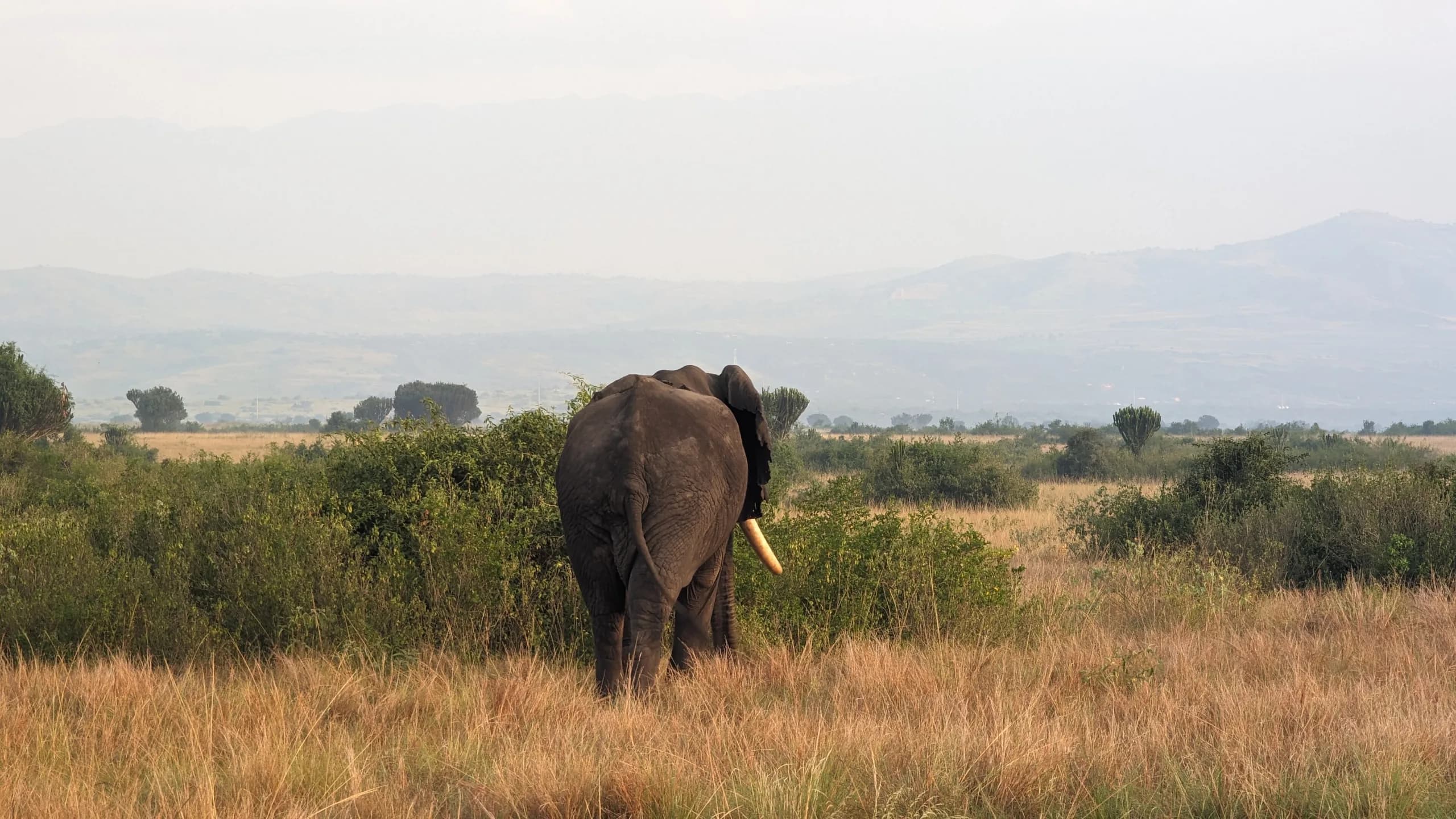
Amboseli's elephants and Kilimanjaro are a package deal. The accepted explanation is that rainfall on the mountain sinks into porous volcanic rock, travels underground into the basin below, and surfaces there as permanent springs and swamps. Those swamps hold large elephant families in open, low country all year, with the mountain behind them. The mountain itself is usually only clear at dawn and in the last hour of light.
That is the whole proposition, and it is worth being blunt about both halves of it. The elephants are close to a certainty. The mountain is not.
Amboseli is a shallow basin sitting in the lee of a very large mountain. Most of it is dry, dusty and thin on grazing, and the bed of Lake Amboseli is seasonal, spending much of the year as bare pan. What makes the park work is a small number of permanent, spring-fed swamps in the middle of that dryness, recharged on the accepted account by water that fell on Kilimanjaro's slopes and moved underground rather than across the surface.
For elephants, that combination is unusually good. Water is reliable and does not disappear when the rains fail. The swamp vegetation is green when everything around it is not. And the country is open, low and short-grassed, so the herds are visible rather than hidden in bush. In much of East Africa you look for elephants; in Amboseli you mostly watch them.
Two consequences follow. Sightings here depend less on season than in parks where animals disperse the moment it rains, because the swamps hold water when the surrounding country does not. And the open ground keeps the herds in plain view rather than in cover, which is why the park is a fixture on almost every serious photographic safari through Kenya.
When is Kilimanjaro actually visible from Amboseli?
Not on demand, and not for most of the day. The mountain is high enough to generate its own weather: as the ground heats through the morning, cloud builds against the slopes and the summit disappears behind it. The clearest views are generally in the first hour or two after sunrise, and sometimes again in the last light before sunset as the cloud sinks.
Practical implications:
- Plan around dawn. If the mountain matters to you, be out of camp before first light, not at eight o'clock.
- Allow more than one morning. A single night is a single roll of the dice; two or three nights makes a clear morning likely rather than lucky.
- Accept that no operator can guarantee it. Anyone who promises you the snow-capped summit behind a bull elephant is selling weather they do not control.
- Remember which country you are in. Kilimanjaro is in Tanzania; Amboseli is in Kenya. You are looking at the mountain across a border, not climbing it from here.
What does it cost to enter Amboseli?
Amboseli is a Kenya Wildlife Service park, and KWS classifies it as a Premium Park — its highest conservation-fee band, shared with Lake Nakuru. The current figures come from the KWS Conservation Fee schedule of October 2025, which is backed by a gazetted statutory instrument: the Wildlife Conservation and Management (Access, Entry and Conservation) (Fees) Regulations, 2025, Legal Notice No. 160 of 2025, commenced 22 September 2025 and applied by KWS from 1 October 2025.
| Charge (foreign non-resident) | Rate |
|---|
| Conservation fee, adult | USD 90 per person per day |
| Conservation fee, child or student | USD 45 per person per day |
| Amboseli + Tsavo West package | USD 150 adult / USD 80 child |
| Amboseli + Tsavo East + Tsavo West package | USD 215 adult / USD 115 child |
| Public campsite | USD 30 per person per night |
| Special campsite | USD 50 per person per night, plus a non-refundable KES 10,000 per week reservation fee |
Two things are worth knowing. The multi-park packages are a genuine saving rather than a marketing line — Amboseli and Tsavo West bought separately would be USD 90 plus USD 80, so the USD 150 package is cheaper than paying twice. And the KWS schedule defines its daily fee as valid for up to 24 hours, which gives you more flexibility around arrival and departure times than some neighbouring parks allow.
One caveat belongs with those figures: the KWS schedule carries no VAT statement at all — it does not declare the dollar amounts inclusive or exclusive. KWS also revises fees on its own schedule, so we confirm the current figures at the point we quote rather than asking you to trust a number on a web page. For how park fees sit inside a whole trip budget, see how much an East African safari costs.
How do Amboseli's fees compare with the other headline parks?
Park fees are set by different authorities in each country and they are not directly comparable line for line, which is where an itinerary budget goes wrong. The headline non-resident adult figures:
| Park | Set by | Non-resident adult fee |
|---|
| Amboseli | Kenya Wildlife Service | USD 90 per day |
| Tsavo East, Tsavo West, Nairobi | Kenya Wildlife Service | USD 80 per day |
| Masai Mara National Reserve | Narok County Government | USD 200 per day July–December; USD 100 January–June |
| Serengeti | TANAPA | USD 70 per day peak (16 May – 14 March); USD 60 low (15 March – 15 May), stated VAT-exclusive |
| Ngorongoro | NCAA | USD 70.80 per person, plus USD 295 per vehicle for each crater descent |
The fine print differs as much as the price. A Masai Mara ticket runs from 06:00 to 18:00 and expires at 18:00 regardless of when you entered — that is the wording of the Narok County Finance Act 2023 itself, not operator folklore. The Mara prices above come from that same 2023 Act, carried forward unchanged in the county's 2024 Finance Bill; no later county Act setting Mara fees could be located, so this too needs confirming before it goes into a quote.
An NCAA permit for Ngorongoro is single-entry, valid for one entry within 24 hours, so an itinerary that crosses the conservation area twice pays twice. NCAA's figures appear VAT-inclusive on the arithmetic, but NCAA states no VAT position and publishes its tariffs page with no effective date at all — unlike TANAPA, which labels its rates VAT-exclusive. TANAPA's most recently published tariff book is the 2023/2024 edition, so any Serengeti figure needs confirming too.
How many days should you spend in Amboseli?
Two nights is the sensible floor. That gives you two dawns for the mountain, two full game-drive cycles, and enough time to work the swamps properly rather than driving through them once. Three nights suits photographers and anyone who wants a specific image rather than a general impression. One night works only as a stopover on a longer route, and you should book it knowing you may not see the summit at all.
What time of year suits Amboseli?
The Kenya Meteorological Department recognises two rainy seasons nationally: the long rains in March, April and May, and the short rains in October, November and December. KMD sets rainy-season onset by a measured criterion rather than a fixed date. For the MAM 2025 season it required a wet spell of at least 20 mm of rainfall over three consecutive days — 10 mm in the northern part of the country — with no subsequent dry spell longer than seven days, and it publishes expected onset dates region by region. No meteorological authority publishes park-level dry-season months for Amboseli specifically, so treat the gaps between the two rain seasons as the drier windows and nothing more precise than that.
The trade-off is straightforward. Drier months mean firmer tracks, more dust, and animals concentrated on the swamps. Wetter months mean greener country, better skies, fewer vehicles, and a higher chance of low cloud sitting exactly where you wanted the mountain. There is no month that is wrong; there are months that suit different priorities. Our fuller treatment of the national picture is in best time to visit Kenya.
How do you actually get the elephant-and-mountain photograph?
- Be in position before sunrise. The mountain is clearest early and the light is worth having anyway.
- Shoot low and wide. The image needs the mountain in it, so a long lens tight on an elephant's head will not do the job. Wider framing, with the herd small in the frame, usually works better than the reverse.
- Use the dust. Amboseli's fine pan dust in low sun is a feature, not a problem — though it is hard on equipment, so bring proper protection for changing lenses.
- Work the swamp edges. Elephants moving between dry ground and water give you movement, reflection and predictable lines.
- Be patient about the composition. The elephants are reliable and the mountain is not, so wait for the mountain and then find the elephants, not the other way around.
What Amboseli does not do well
Amboseli is not a forest park, and it is not a big-cat park in the way the Mara is — predator viewing happens but it is not the reason to come. The landscape is open and dusty, which some travellers find stark. And the park is compact and well known, so at the popular swamps in high season you should expect other vehicles.
If your priority is predator density or the migration, Amboseli belongs in the itinerary as a complement rather than the centrepiece. If your priority is elephants, landscape and the mountain, nothing else in Kenya offers the same combination.
What does Amboseli combine with?
It sits naturally on a southern Kenya loop. The standard pairing is Amboseli with the Masai Mara — the two are very different in character, which is the point — and we build exactly that on Kenya: Mara and Amboseli. The KWS package fee also makes an Amboseli and Tsavo combination cheaper than the parks bought separately, which is worth knowing if you want more time in the field for the same conservation spend. If Big Five viewing is the priority, the Mara belongs in the plan too.
On entry formalities, Kenya uses an electronic travel authorisation with a standard processing fee of USD 30 and an optional expedited service at an additional USD 100; the wider regional picture is in our East Africa Tourist Visa guide.
Before you book
Kenyan and Tanzanian government fees change on the authorities' own timetables, and several of the published schedules are older than they should be. We confirm every park fee, permit price and concession charge in writing at quote stage rather than carrying last year's numbers forward. Lodge rates, vehicle costs and drive times are quoted the same way — specific to your dates, not lifted from a table.
You can read more about the park at Amboseli National Park, start a route with us on plan your safari, or simply get in touch and tell us how many dawns you want under the mountain.