Ziwa Rhino Sanctuary is a fenced sanctuary of savannah and swamp in Nakasongola district, roughly three hours north of Kampala, and it is the only place in Uganda where you can track southern white rhino on foot. Rangers locate the animals in the morning, you drive to a point nearby and walk in behind a guide, and you end up standing on the ground near them. It takes an hour or two, runs daily, and sits about halfway to Murchison Falls.
Why is Ziwa the only place in Uganda to see rhino?
Because Uganda lost its wild rhino entirely. Both the black rhino and the northern white were shot out during the conflicts of the 1970s and early 1980s, and by the mid-1980s there was nothing left in the wild anywhere in the country. That is the uncomfortable fact behind every Uganda safari brochure that lists the Big Five: for decades, one of them simply was not there.
Ziwa is the answer to that. The sanctuary was established in 2005 by Rhino Fund Uganda in partnership with the Uganda Wildlife Authority, and stocked with southern white rhino rather than the northern subspecies that was lost. The herd has bred and grown since. The number changes with every birth, so instead of printing a figure that ages badly, we confirm the current count with the sanctuary when we quote your dates.
The long-term intention has always been reintroduction into Uganda's national parks, and there is now a line on paper: UWA's revised tariff structure, effective 1 January 2027, introduces a rhino tracking fee for Ajai Wildlife Reserve at USD 20 per foreign non-resident adult and USD 5 per child. What that line does not tell you is what is actually operating there on any given date, so we ask rather than guess. As things stand, Ziwa is the place you go.
What actually happens on a rhino track?
The mechanics are simpler than a primate trek. Rangers and trackers locate the animals at first light and stay with them, so their position is known before you arrive. You get a briefing at the headquarters, drive to a point close to where the animals have settled, and then walk in on foot through open savannah and light woodland. There is no searching, no forest, no altitude and no machete work.
Then you stand there. A white rhino is a very large grazing animal that spends most of the day feeding or lying up, and the encounter is calm rather than dramatic. Your guide sets the distance and the approach angle, keeps the group together and upwind where possible, and will move you if the animals move. It is quiet, close, and completely unlike watching wildlife from a raised vehicle: much of the difference is simply being on the ground rather than in a seat.
Practical points worth planning around:
- Closed walking shoes, long trousers and a hat. The ground is uneven and the grass can be long and wet.
- Water, and sun cover. There is very little shade once you are out.
- Neutral colours, and no bright white. Quiet voices throughout.
- A camera with a moderate zoom is plenty. This is not a long-lens sighting.
- The first tracking slot of the morning is the coolest and the animals are more active in it.
How fit do you need to be?
Much less fit than for anything else on a typical Uganda itinerary. The terrain is essentially flat, the distance is short and the pace is set by the group. If a gorilla trek is the thing you are quietly worried about, read our note on gorilla trekking fitness and difficulty and then set Ziwa alongside it — they are not in the same category of effort.
On age, be careful with what you read elsewhere. Ziwa is not a UWA national park and does not run on the UWA primate rules, so it sets its own conditions. For contrast, UWA's own guidelines set a minimum age of 15 for gorilla tracking and 12 for chimpanzee tracking. We confirm Ziwa's current position with the sanctuary for your party rather than quoting a number that may be out of date.
What does it cost, and who sets the price?
The distinction that trips people up is jurisdictional. Ziwa is a sanctuary run by Rhino Fund Uganda, not a UWA national park, so its tracking fee does not appear on the UWA conservation tariff at all. It is set by the sanctuary, revised on the sanctuary's own schedule, and we confirm the current figure at the point of quoting rather than publish one that has quietly moved.
The UWA fees on the same stretch of itinerary we can quote, because they are published:
| Item | Who sets the fee | Published position |
|---|
| Rhino tracking at Ziwa | Rhino Fund Uganda | Not on the UWA tariff; confirmed at quote stage |
| Shoebill canoe and night walk at Ziwa | Rhino Fund Uganda | Not on the UWA tariff; confirmed at quote stage |
| Murchison Falls park entry, adult | UWA | USD 45 per foreign non-resident adult per 24 hours |
| Murchison Falls park entry, child (5–15) | UWA | USD 25 per 24 hours; under-5s exempt |
| Launch cruise, Murchison Falls | UWA | USD 30 per person |
| Rhino tracking, Ajai Wildlife Reserve | UWA | USD 20 adult / USD 5 child, from 1 January 2027 |
Two caveats on that table. UWA's published rates document remains the July 2024 to June 2026 conservation tariff, which is still the tariff served from its rates page, with the next revision scheduled for 1 January 2027; the tariff's cover states that fees are subject to change without prior notice. The Ajai figure is not in that booklet at all — it comes from the Executive Director's circular of 26 February 2026, which sets the 2027 rates. A Murchison entry ticket runs 24 hours from the time you enter, and extra time is charged as an extra day. For how these stack up across a whole trip, see how much an East African safari costs.
When is the best time to go?
Tracking runs every day of the year and the rhino do not move far, so there is no bad month at Ziwa. What changes is the walking and the birding.
The Uganda National Meteorological Authority describes two national rainfall seasons, March–April–May and September to December, with December to February typically dry across the country and February the hottest month. UNMA also notes that northern and parts of eastern Uganda receive substantial rainfall in June–July–August, which is worth knowing when you are heading up the Gulu highway. In practice the drier windows give you firm tracks and an easy walk in; the wetter months bring long grass and wetter footing, but not difficult walking. If the shoebill in the Lugogo swamp is part of why you are coming, the drier months make the canoe route through the papyrus more reliable. There is more on national timing in our guide to the best time to visit Uganda.
How does Ziwa fit into a Murchison Falls itinerary?
Geography is the whole argument for stopping. Ziwa sits on the Gulu highway with the turning at Nakitoma, roughly halfway between Kampala and the southern sector of Murchison Falls National Park via Masindi. It converts a long, dull transfer day into a day with a wildlife encounter in the middle of it.
Three ways to slot it in:
- Track northbound. Leave Kampala early, track mid-morning, break for lunch, continue to Murchison for the evening. The straightforward version, and it breaks the drive properly.
- Stay the night. Sleep at or near the sanctuary, take the first tracking slot of the morning and add the shoebill canoe or the night walk. Costs you a day and buys you the two activities the day visitors miss.
- Track southbound. Coming back from Murchison, this works, but you arrive later in the day and the light and the heat are both worse.
One hard constraint: the sanctuary has no airstrip, and the Murchison airstrips are well past it, so Ziwa only works on a road leg. If you fly to Murchison, you skip Ziwa entirely. That is a genuine argument for driving at least one leg of that trip, which we set out in fly-in versus road safari in Uganda. It also affects how many days you need overall — see how many days for a Uganda safari. Both the Uganda Grand Circuit and Uganda Primates and Savannah routes use the road leg for exactly this reason.
What else is there to do at Ziwa?
There is more here than a lunch stop suggests.
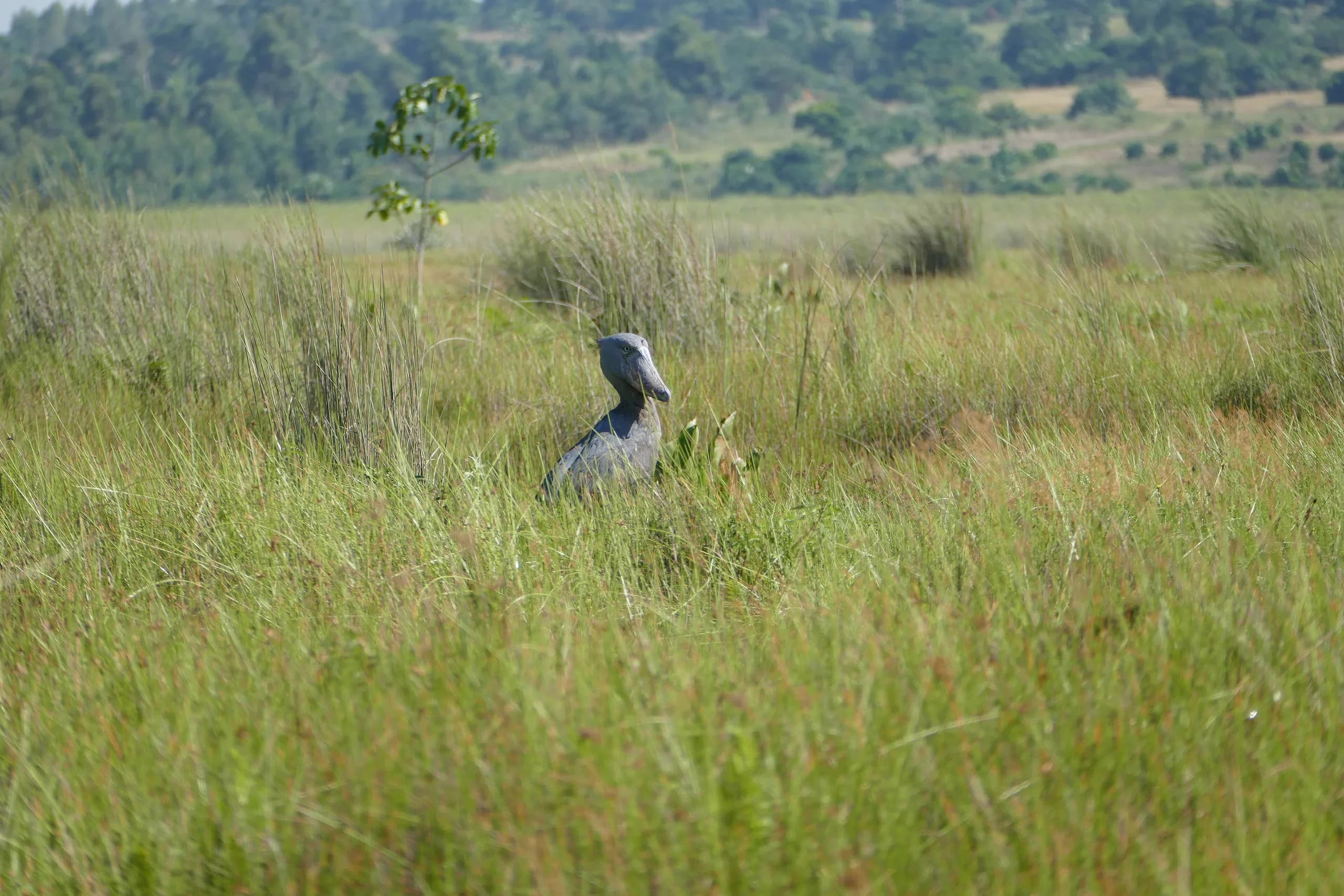
- Shoebill canoe. A dawn trip by canoe into the Lugogo swamp, poled through papyrus. Shoebill are never guaranteed anywhere, but this is one of the more workable places in Uganda to look for one.
- Night walk. Guided, on foot, for bush pig, white-tailed mongoose and nightjars. Genuinely different from a night drive.
- Birding. The mix of savannah, woodland and swamp inside one fenced area makes for a long list, which is why birders stay a night rather than passing through.
- Other mammals. Bushbuck, oribi, duiker, warthog, bush pig, hippo and vervet monkey all occur inside the sanctuary.
Is Ziwa worth it if you have done Big Five safaris elsewhere?
An honest answer: if you have spent time in a private reserve in southern Africa where white rhino are a routine vehicle sighting, the animal itself will not be new. What is new is being on foot with it, and that changes the encounter more than you would think. It is also a conservation project you are funding directly rather than a park you are passing through.
Equally, Ziwa is a fenced, actively managed breeding sanctuary. It is not wilderness, and anyone selling it to you as wilderness is overselling. If your trip is built around Big Five game viewing at scale, Ziwa is a worthwhile hour on a transfer day rather than a destination in its own right. If your trip is a Uganda circuit, it completes something the country lost and has spent twenty years rebuilding.
How do you book it?
Ziwa is normally booked as part of a wider Uganda itinerary rather than on its own, because the drive only makes sense in the context of where you are going next. There is a lodge and simple bandas inside the sanctuary, and fuel and food on the highway at Nakasongola and Luweero, so a lunch stop can go either way.
One thing to ask about rather than assume: land, lease and custody arrangements between Rhino Fund Uganda and the wildlife authority have been the subject of public disagreement and have shifted more than once, and that has affected access before. We confirm current access with the sanctuary when we quote, rather than treating a daily departure as a given.
Tell us your dates and we will confirm the current sanctuary fee, whether the shoebill canoe is running usefully at that time of year, and whether a night at Ziwa earns its place in your route. There is more detail on the destination itself on our Ziwa Rhino Sanctuary page, or start with plan your safari and we will come back with what is actually available.