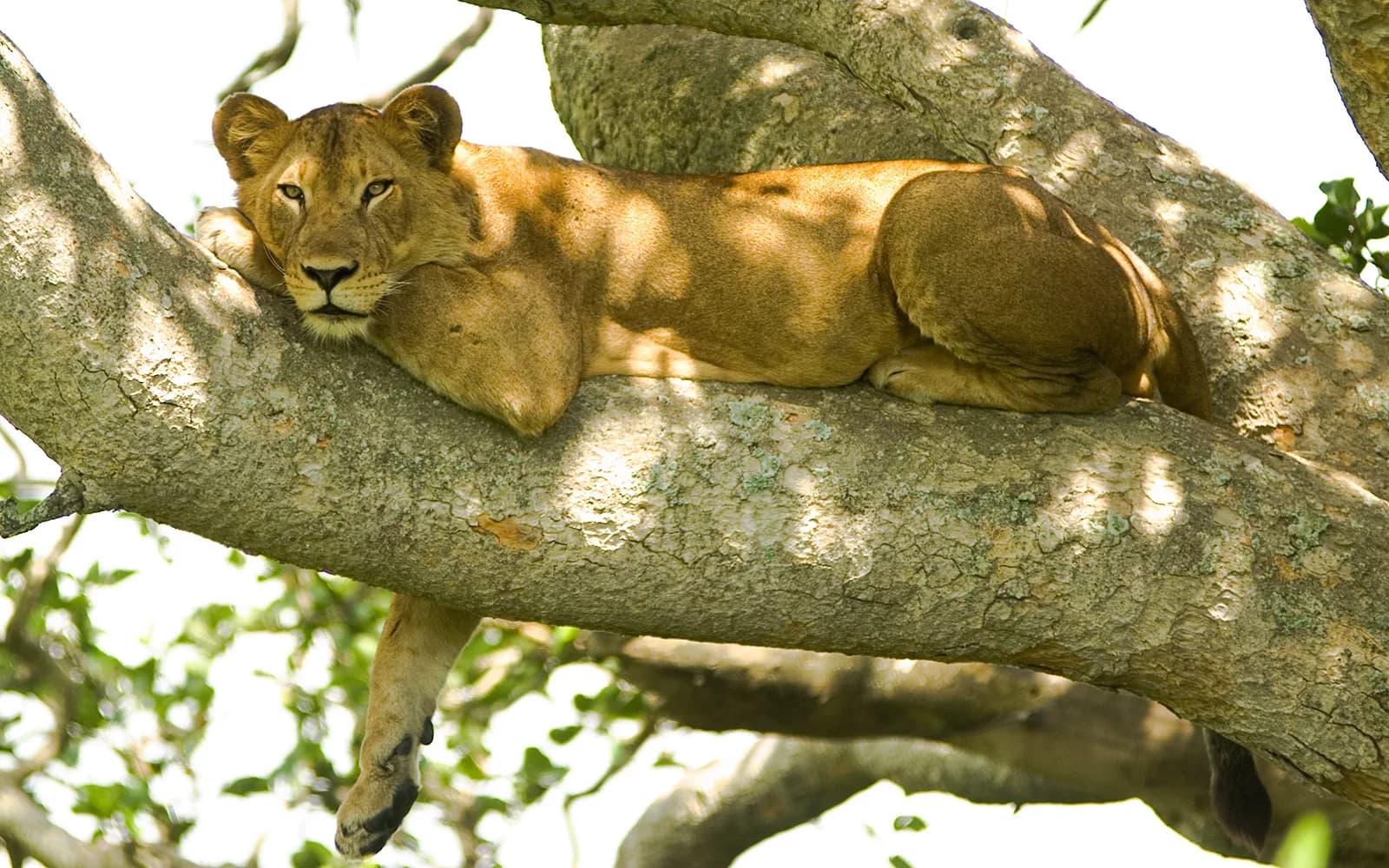
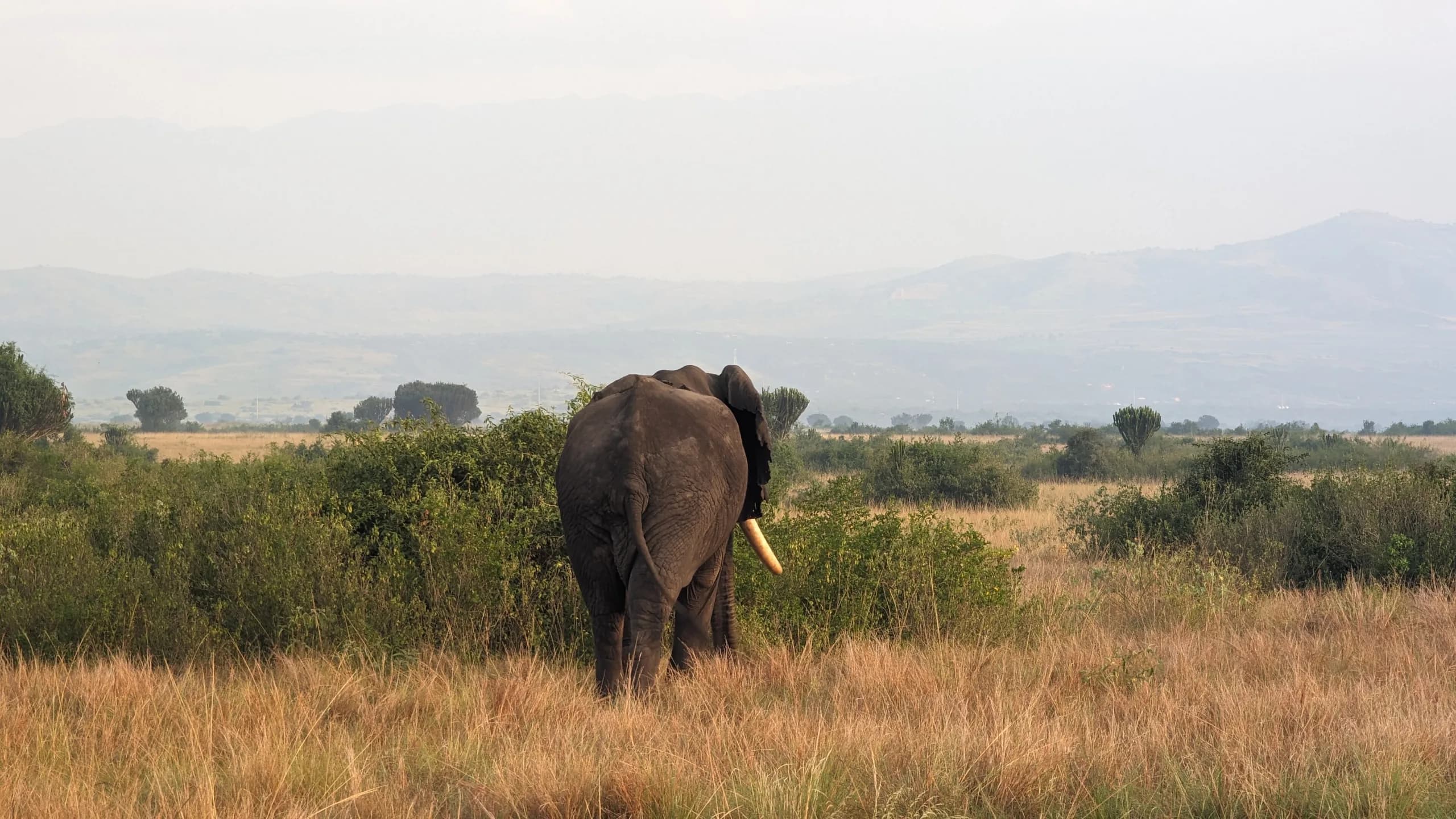
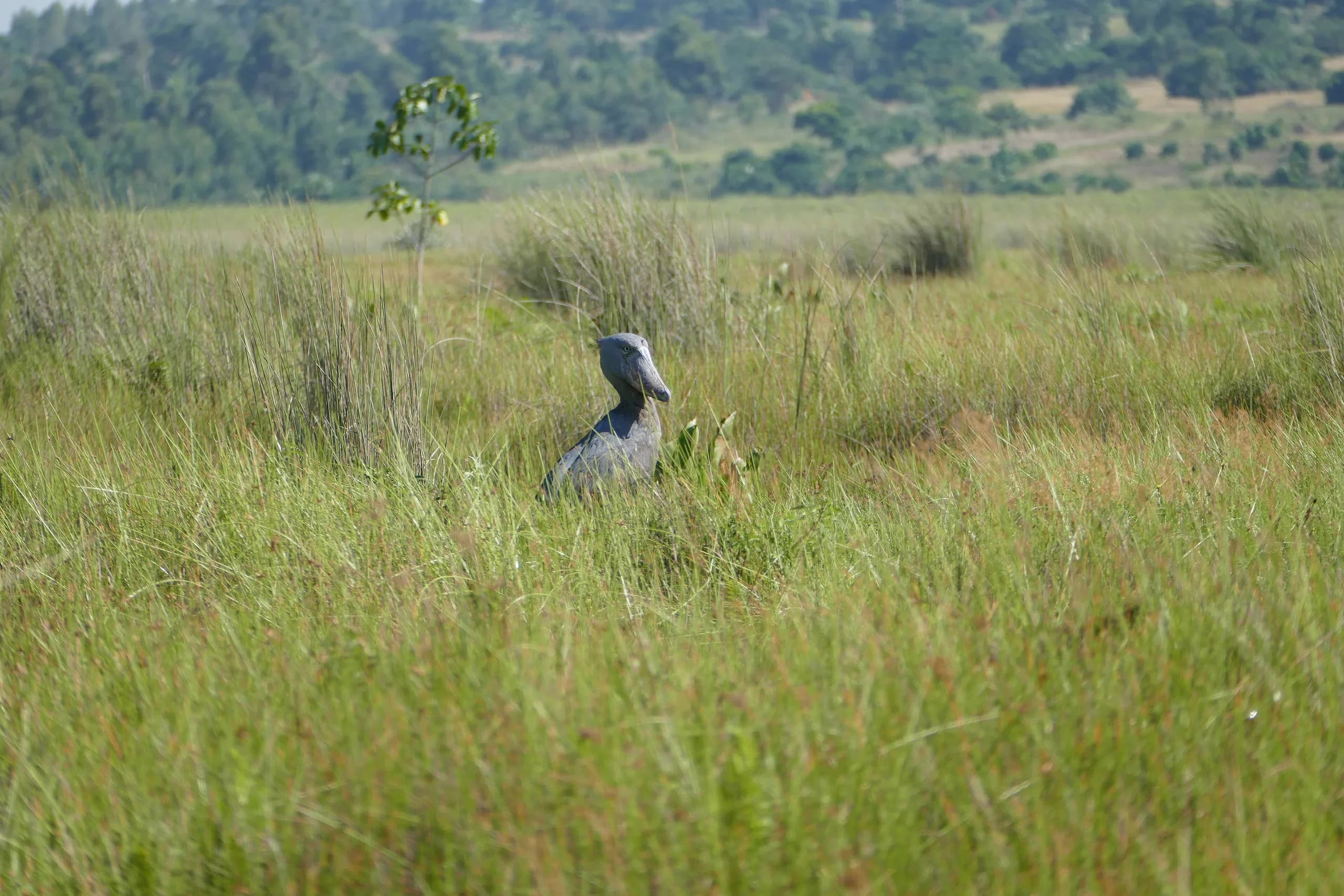
Ishasha is the southern sector of Uganda's Queen Elizabeth National Park, and its lions genuinely do rest in trees — an unusual habit among lions. But sightings are never guaranteed on any given drive. The detour is worth building in if you are already travelling between Queen Elizabeth and Bwindi, because Ishasha sits on that route. It is rarely worth a dedicated journey.
That is the short answer, and most of the rest of this article is about the second half of it: what you are actually buying with the time, and the itineraries where it stops making sense.
What are the Ishasha tree-climbing lions?
They are ordinary African lions that rest up in trees during the day rather than staying on the ground, usually in the broad fig trees that stand out across the Ishasha plains. What you tend to see first is a foreleg or a tail hanging over a branch.
One caveat before you read further, because it applies to this section and the next. There is no published study of the Ishasha lion population that we can point you to, and no wildlife-authority source we can cite for the behaviour. Treat every account of these lions, this one included, as reported description rather than research. Everything further down this page that carries a price or a date is sourced, and we say where it comes from.
Two things are worth being clear about. First, lions elsewhere climb trees too, so this is a difference of frequency rather than of species or subspecies. Second, it is the habit of a particular population in a particular place, not a fixed daily routine you can book. Some days the prides are on the ground, in long grass, or simply somewhere else in the sector.
Why do the lions in Ishasha climb trees?
Nobody has settled this, and you should be sceptical of any operator who states a single cause as fact. The explanations commonly offered include escaping biting insects at ground level, getting above the heat and into moving air, keeping clear of damp ground, gaining a vantage point over grass tall enough to hide a buffalo, and the habit simply being passed on within a pride once it takes hold.
All of them are plausible. None is proven. We would rather leave it there than hand you a tidy story that nothing supports.
How likely are you to see them?
Nobody publishes a sighting rate for Ishasha, and any operator quoting you a percentage has invented it. We are not going to give you a number either. What we can do is set out what moves the odds, because most of it is decided when the itinerary is written rather than on the day.
- Time in the sector. Two drives beat one. A night in or beside Ishasha changes the trip; a two-hour pass-through mostly does not.
- Grass height and ground conditions. After heavy rain the grass is long and the tracks are soft, which makes both the driving and the spotting harder.
- Your guide. Ishasha rewards a driver-guide who knows which fig trees the prides have been using and who talks to the other vehicles. This is the factor you can actually buy, rather than hope for.
Where is Ishasha, and does it fit your route?
Ishasha is the southern part of Queen Elizabeth National Park, below the main Mweya area, close to the border with the Democratic Republic of Congo. Its practical significance for planning is that it lies on the road between the northern part of Queen Elizabeth and the gorilla sectors of Bwindi Impenetrable Forest.
That geography is the whole argument. If your itinerary already runs Kibale, then Queen Elizabeth, then Bwindi — the standard shape of a Uganda circuit — Ishasha is not really a detour at all. It is a place to break a long transfer day and turn driving time into game-viewing time. If your itinerary does not include Bwindi, the same visit becomes a long out-and-back for one behaviour you may not see.
Is the detour worth it for your trip?
| Your itinerary | Verdict | Why |
|---|
| Queen Elizabeth to Bwindi, driving | Yes, add a night | Ishasha is on the route. A night there shortens the transfer and buys you two drives instead of none. |
| Queen Elizabeth to Bwindi, flying | Usually no | Flying is what you paid for to avoid the road. Adding Ishasha reinstates the drive you removed. |
| Short gorilla-focused trip | No | On a compressed short break every day is committed. Do not spend one on a maybe. |
| Photographic trip | Often yes | A lion in a fig tree is a picture you cannot easily get elsewhere, and photographic itineraries are built to absorb waiting. |
| First safari, wanting volume of game | Probably no | Ishasha is quiet and open. If you want density and variety, put the time into the northern sector or into Kenya and Tanzania. |
| Family trip with young children | Depends on tolerance for road | The sector is rewarding but the days involve sitting in a vehicle. See family safaris. |
What does an Ishasha visit cost in park fees?
Ishasha is inside Queen Elizabeth National Park, so there is no separate Ishasha park fee — you pay Queen Elizabeth entrance. The figures below are Uganda Wildlife Authority foreign non-resident rates from its Conservation Tariff for July 2024 to June 2026, which UWA still links as its current rates document, with the 1 January 2027 figure taken from UWA's tariff-change circular of 26 February 2026 (Ref TDO 93/04). UWA states that fees may change without prior notice, so we confirm the live figures when we quote.
Read the table as Queen Elizabeth fees that bear on an Ishasha visit, not as a menu of what Ishasha offers. Neither the launch trip nor Kyambura Gorge is in the Ishasha sector; both sit elsewhere in the park and are priced park-wide.
| UWA line item | Foreign non-resident rate | Notes |
|---|
| Queen Elizabeth park entrance, adult | USD 40 per 24 hours | Children USD 20. Entrance is charged independently of package activities such as tracking and birding. |
| Launch trip, Queen Elizabeth | USD 30 per person | Approximately two hours; the Queen Elizabeth launch carries a maximum of 40 people. It runs on the Kazinga Channel in the north, not at Ishasha. |
| Chimpanzee tracking, Kyambura Gorge | USD 100 per person | Excludes park entrance, so entrance is charged on top. Rises to USD 200 on 1 January 2027. UWA also introduced discounted low-season chimpanzee tracking for April, May and November, and its circular does not say whether that applies at Kyambura, so we confirm it at quote rather than publish a figure. |
What is not in that table is the part that actually decides your budget: the vehicle, the guide and the bed. Lodge rates in and around Ishasha are commercial and move with season and property, so we do not publish a figure here. You get real numbers at quote stage rather than a range that will be wrong. Our general note on what an East African safari costs explains how the components stack up.
When is the best time to look for them?
The Uganda National Meteorological Authority describes two major rainfall seasons nationally — March to May, and September through December — and states that December to February is typically dry across Uganda, with February the hottest month of the year. Ishasha sits in the south-west, which follows that pattern; it is northern and parts of eastern Uganda that also take substantial rainfall in June, July and August.
The drier windows generally mean firmer tracks and shorter grass, which helps both the driving and the spotting. How firm a rule that is, is another question. The longest instrumental record in the south-west comes from Ruhija in Bwindi, at 2,400 m — higher, cooler and wetter than Ishasha, so read it as a regional tendency rather than an Ishasha forecast. Across that 13-year record, from 1987 to 1999, the two-season pattern was a tendency and not a rule: in 1992 and 1999 the March peak was so weak that the distribution was nearly unimodal, and July 1988 delivered heavy rain despite being a dry-season month. The one thing that held in every year of the record was that June, July and August were the driest months. Our fuller guide to the best time to visit Uganda for gorilla trekking goes into this properly.
One planning point often decides the calendar for people combining Ishasha with gorillas. UWA's low-season gorilla permit rate of USD 600 for foreign non-residents, against the standard USD 800, applies in April, May and November. Those are wetter months, and UWA states that low-season permits cannot be rescheduled. That is a genuine trade-off rather than a free saving.
How does Ishasha fit a wider Uganda itinerary?
The sequence that usually works puts Ishasha between the northern Queen Elizabeth sector and Bwindi, with a night on the way south. That gives you the Kazinga Channel launch and the northern plains first, then Ishasha's quieter, more open country, then the forest.
Two practical constraints shape it. First, Queen Elizabeth entrance runs in 24-hour blocks from the time you enter, so a night inside the park is a cleaner arrangement than repeated day entries. Second, and more important, the gorilla trek is the fixed point of any such trip. Since 1 March 2026 UWA has suspended its seven-day reservation window, so there is no free hold period at all: a permit is secured only on full payment at the time of booking. In Uganda, UWA sells gorilla and chimpanzee permits to foreign non-residents through licensed tour operators only, so that payment runs through an operator rather than a public checkout. The gorilla permit itself includes park entrance for the day of tracking, so Bwindi entrance is not charged again on top of it.
Practically, that means your Bwindi date is locked before the flexible parts of the route are built around it — not the other way round. Ishasha then becomes a question of what to do with the days on either side, which is a much easier question to answer well. If you would rather see how the whole thing assembles, start at plan your safari or look at our Uganda itineraries.
The honest summary
Ishasha is one of the more distinctive things in East African wildlife viewing, and it is underrated as a place to spend a night rather than pass through: quiet, open country, fig trees, and not many other vehicles. It is also a place that owes you nothing on any given day.
Build it in when the route already passes through and you can give it a night. Leave it out when the only way to include it is to take a day from somewhere that will reliably deliver. If you want us to look at your dates and say plainly which of those two situations you are in, tell us what you have in mind.