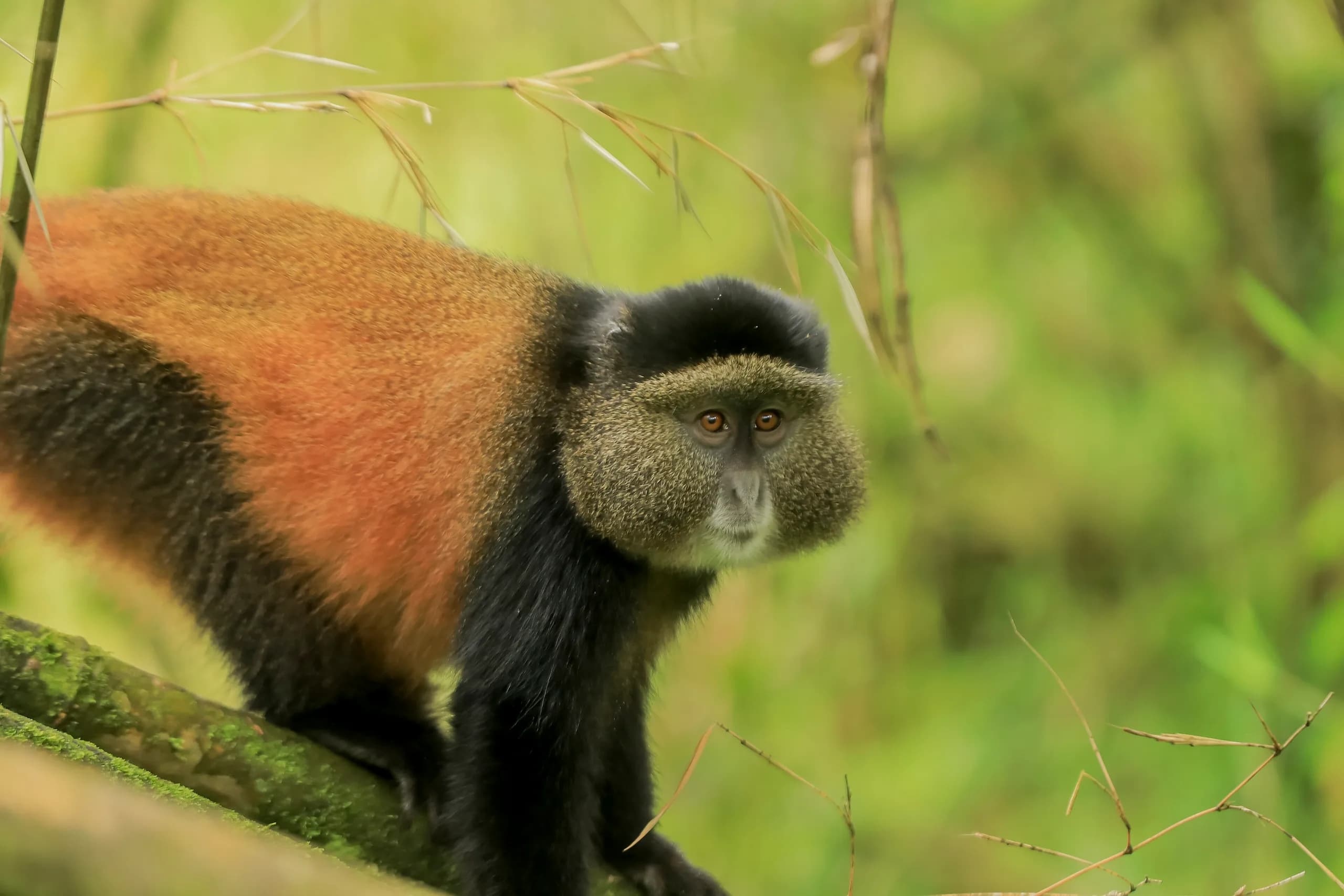
Golden monkey trekking is a guided walk to a habituated troop of golden monkeys in the bamboo of the Virunga volcanoes. Two parks in East Africa sell permits for it. In Uganda it is Mgahinga Gorilla National Park, where the Uganda Wildlife Authority (UWA) charges foreign non-residents USD 60 for the permit. In Rwanda it is Volcanoes National Park, where the Rwanda Development Board (RDB) charges USD 100.
It works best as an add-on rather than as the reason to travel. On a trip built around gorilla trekking it is the cheapest primate permit either park sells, and it gives the morning before or after the gorilla trek a purpose beyond a road transfer.
Where can you track golden monkeys?
Golden monkeys live in the bamboo belt of the Virunga range, the chain of volcanoes shared between Uganda, Rwanda and the DRC. On the Ugandan and Rwandan sides, two parks sell the activity:
- Mgahinga Gorilla National Park, Uganda. UWA lists both a golden monkey tracking permit and a separate golden monkey habituation experience here. Both require prior booking, and neither includes park entrance.
- Volcanoes National Park, Rwanda. RDB sells golden monkeys as one of its standard Volcanoes products, alongside mountain gorilla tracking, the Dian Fossey tomb hike, Bisoke, Karisimbi and the nature walk. RDB's booking pages list no golden monkey habituation product.
The two parks physically adjoin one another across the border, so you are entering the same continuous bamboo belt from opposite sides of the same mountains. What differs is what the authority charges and how the day is run.
What does a golden monkey permit cost in Uganda and Rwanda?
Both authorities set these fees themselves and revise them on their own schedules, so treat the figures below as current rather than fixed. UWA's rates come from its Conservation Tariff; RDB's come from the live Visit Rwanda booking portal.
| What you pay for | Mgahinga, Uganda (UWA) | Volcanoes, Rwanda (RDB) |
|---|
| Golden monkey permit, foreign non-resident | USD 60 | USD 100 |
| Park entrance on top of the permit | Yes. USD 40 per adult per 24 hours, USD 20 per child (Category A park) | RDB publishes no separate Volcanoes entry fee |
| Habituation version | USD 100, park entrance excluded | Not listed on RDB's booking pages |
| Maximum visitors per troop per day | Not published for this activity | 16 |
| Reporting time | Not published for this activity | 07:00 |
| Permit plus park entrance for one trekking day | USD 100 | USD 100 |
That last row is the point most comparisons miss. Uganda looks USD 40 cheaper on the permit line, but UWA prices the golden monkey permit exclusive of park entrance, and Mgahinga is a Category A park at USD 40 per adult per 24 hours. Add the two and a single trekking day in Mgahinga costs the same USD 100 as Rwanda's permit. Uganda only comes out ahead if you are already inside Mgahinga on a day your entrance is covered.
One thing worth knowing: your Uganda gorilla permit already includes park entrance for the day of tracking. Golden monkeys are a separate morning, so a second day in the park attracts entrance again. That gorilla permit is USD 800 for a foreign non-resident, or USD 600 in April, May and November under UWA's low-season rate, and UWA states low-season permits cannot be rescheduled. The standard permit stays at USD 800 under the revised UWA structure taking effect on 1 January 2027.
Rwanda's other visitor categories
RDB publishes a full tier structure for golden monkeys at Volcanoes:
- Foreigner (non-resident): USD 100 adult
- Foreign resident in Rwanda: USD 65 adult, USD 45 student or child
- East African citizen: USD 65 adult, USD 45 student or child
- East African foreign resident: USD 80 adult, USD 45 student or child
- Rwandan citizen: RWF 4,000 adult, RWF 2,000 student or child
Residents claiming a reduced rate need to prove it. RDB requires foreign residents in Rwanda or the EAC to hold at least four consecutive months of residency status or a work permit, and EAC residents to present an EAC ID card or passport.
Does the price change in low season?
No. In February 2026 UWA introduced discounted low-season permits for April, May and November, but those apply to gorilla and chimpanzee tracking only. Golden monkey tracking is not among them, and it is not on the list of items whose rates change under UWA's revised structure taking effect on 1 January 2027. RDB's headline low-season offer is a 30% discount on gorilla permits from November to May, conditional on combining the trip with nights and activities in Akagera or Nyungwe. Golden monkeys sit outside that too.
So if you are timing a trip around permit discounts, the saving is on the gorilla permit: in Uganda, USD 600 instead of USD 800 in April, May or November. UWA states low-season permits cannot be rescheduled, so the saving costs you flexibility on the gorilla date. The golden monkey permit costs the same in every month.
What is the golden monkey habituation experience?
UWA sells a golden monkey habituation experience at Mgahinga for USD 100 per foreign non-resident, again excluding park entrance. It is the only habituation product either authority lists for golden monkeys.
Be careful about what you assume it includes. UWA's published four-hour contact time applies to the gorilla and chimpanzee habituation experiences, set out in its gorilla and chimpanzee tracking guidelines. Those guidelines do not cover golden monkeys, and the tariff does not state a contact time for either golden monkey product. The same applies to the one-hour limit widely quoted for the standard golden monkey trek: that hour is a published rule for gorillas and chimpanzees, not one we can point to in writing for golden monkeys. If contact time is what you are paying the extra USD 40 for, we confirm the day's format with the park before we book it rather than promising you a number.
What happens on the day?
In Rwanda, RDB sets a 07:00 reporting time for Volcanoes National Park activities other than Karisimbi and the Musanze caves, which report at 09:00, and park offices run 07:00 to 17:00. Group size is capped at 16 people per golden monkey troop per day, which is double the eight allowed on a gorilla group in either country. Expect more people around you than on a gorilla trek.
UWA does not publish a start time or a group cap for golden monkey tracking, only that prior booking is required. UWA confirms the reporting time and the meeting point when the permit is issued, and we pass that on before you travel.
Golden monkey mornings are usually shorter than a gorilla trek. That is operator and guide expectation rather than a published rule, and it is not a guarantee. The terrain and the altitude are the same Virunga terrain and altitude either way, and UWA describes gorilla treks in Bwindi as lasting between two and seven hours and requiring moderate fitness. Come in the same boots. Our gorilla trek packing list covers everything you need for both.
Plan for the photography rather than hoping for it. Fast-moving primates high in bamboo canopy light are a demanding subject, and if images matter to you that is a conversation to have with us before you book a photographic safari.
When is the best time to go?
The Virungas are wet mountains and there is no dry month, only drier ones.
- Rwanda. Research at Volcanoes National Park describes a four-season cycle: a short dry season from December to February, heavy rains from March to May, a long dry season from June to August, and short rains from September to November. Rainfall at Volcanoes runs to roughly 1,900 mm a year between 3,000 and 3,600 m, and varies strongly with elevation rather than evenly across the park.
- Uganda. The Uganda National Meteorological Authority describes two national rainfall seasons, March to May and September to December, with December to February typically dry across the country. The nearest long-term forest record to Mgahinga is the Institute of Tropical Forest Conservation's monitoring at Ruhija in Bwindi, where June, July and August were the driest months in every year of a 13-year record.
Practically: June to August and December to February are the more comfortable windows on both sides. But the Ruhija record also shows July 1988 delivering heavy rain in what should have been a dry month, so a dry month is a probability, not a promise. We plan around that rather than betting on it.
How do you book a golden monkey permit?
The two systems are different, and the difference matters if you are also buying gorilla permits.
- Uganda. UWA sells foreign non-resident gorilla and chimpanzee permits only through tour operators licensed by the Uganda Tourism Board, and states it has no agents inside or outside Uganda. That licensed-operator rule is written for gorilla and chimpanzee permits. Golden monkey tracking is not named in it, and UWA lists other products and services as payable at its reservations office or at park gates. Prior booking is still required. Since 1 March 2026 the seven-day unpaid reservation window has been suspended, so nothing is held while you decide: permits are secured only on full payment at the time of booking.
- Rwanda. RDB allocates on a first-come, first-served basis, through Irembo, the Visit Rwanda site, or RDB's own reservation and sales offices. RDB works only with licensed Rwanda-based operators, so an international operator has to book through a local one.
Rwanda caps each golden monkey group at 16 visitors a day. RDB does not publish how many groups are open to tourism, so treat availability as unknown rather than assumed. If your gorilla date is fixed, book the golden monkey permit for the adjacent day at the same time, not later.
Is it worth adding to a gorilla trip?
Yes, on two conditions. The first is that you are already in the Virungas for gorillas. The second is that you have an honest sense of what you are buying. Go in expecting a fast, chaotic troop of monkeys rather than the emotional weight of a gorilla trek, and it lands well.
Where it earns its place is in the shape of the itinerary. A gorilla trek is a single morning, and the day either side of it can easily go to nothing. Golden monkeys turn one of those into something. In Mgahinga it also gives you a reason to spend a second night rather than passing through in an afternoon.
If you are still choosing which side of the border to trek from, our comparison of gorilla trekking in Uganda versus Rwanda covers the decision properly, and our combined Uganda and Rwanda itinerary shows how the two fit together. When you are ready to put dates against it, tell us what you have in mind and we will confirm the current permit fees and availability before we quote.