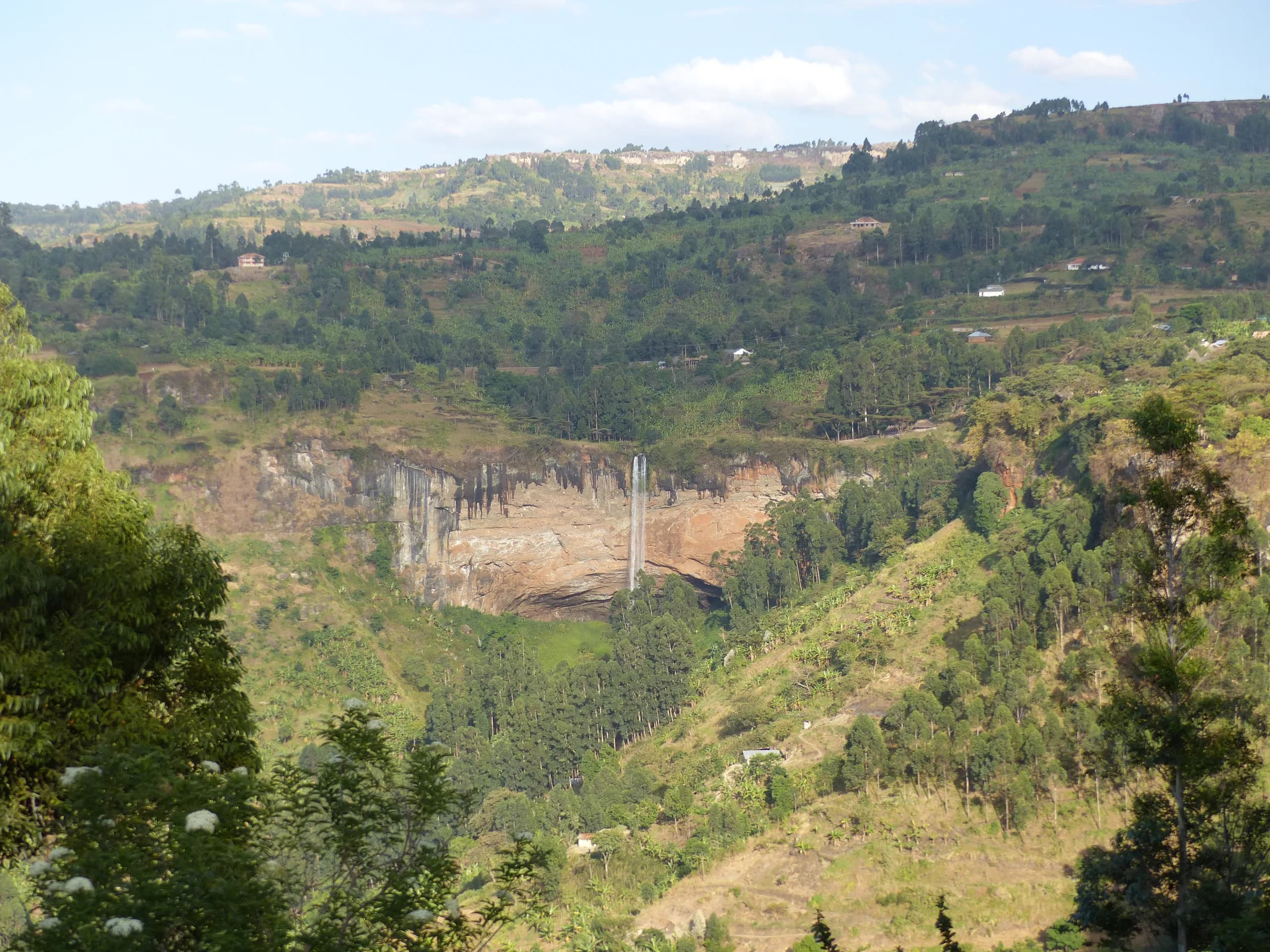
The Sipi Falls hike is a guided walk on the western slopes of Mount Elgon in eastern Uganda, linking three waterfalls by footpath through smallholder farmland and coffee gardens. Done as a circuit it takes three to four hours with a local guide. It sits outside Mount Elgon National Park, so there is no Uganda Wildlife Authority gate and no park entry fee. It is a walk rather than a climb, but it is not a gentle one.
Do you need a permit or a park fee for Sipi Falls?
No. There is no permit in the sense that gorilla and chimpanzee trekking have permits, and there is no park gate. Sipi Falls sits outside Mount Elgon National Park, on community and private land. Guides are arranged in Sipi village through the local guides association, the rate is set locally rather than in a national tariff, and it is modest. One or two of the best viewpoints sit on private land and charge a small separate amount at the gate. Both are set by the community and the landowners rather than by any authority, so we confirm the current figures when we quote.
The confusion worth clearing up is that Mount Elgon National Park is a separate proposition, entered above the village at the Kapkwai Forest Exploration Centre. Park entry and trekking fees there are set by the Uganda Wildlife Authority and have nothing to do with what you pay in Sipi. If your days include Kapkwai — the forest day walks, the caves, or the trailhead into the mountain — that is where a UWA fee applies, and we itemise it separately on the quote rather than letting it turn up as cash at a barrier.
One caution applies to any UWA figure you find published, ours included until we have confirmed it. The rates document UWA currently serves as its tariff is the Conservation Tariff for July 2024 to June 2026. Its printed validity ran to 30 June 2026, no successor booklet has been published, and the cover states that fees are subject to change without prior notice. UWA has separately announced a revised tariff structure taking effect on 1 January 2027. Treat any park figure you read anywhere as indicative, and let us confirm the live rate at quote stage.
There is one saving worth knowing about. A Uganda gorilla tracking permit includes one day's free entrance to Mount Elgon National Park and Toro-Semliki Wildlife Reserve, usable within one month before or after your tracking date. If you are doing gorilla trekking anyway and the dates line up, a Kapkwai day is one you have already paid for. The permit itself is USD 800 for a foreign non-resident, or USD 600 in April, May and November, and UWA states that low-season permits cannot be rescheduled; the gorilla tracking rate is unchanged in the structure taking effect on 1 January 2027. The full picture is in our guide to Uganda gorilla permits. Note that this free day attaches to the gorilla permit — do not assume a chimpanzee permit carries it.
Porters are a Mount Elgon trekking arrangement rather than a falls-walk one. On the three-falls circuit you carry your own day pack.
How hard is the Sipi Falls walk, really?
Harder than the photographs suggest. The distance is modest; the gradient and the surface are what make it work. Sections are steep enough to want your hands, in places it is a genuinely steep scramble on wet red clay, and there are two or three places where a slip matters. The clay holds water for days after rain, so the ground you walk on is set by the weather of the previous week rather than the morning.
- There is no technical climbing and no ropes, but do not read that as an easy path.
- Boots with real grip rather than trainers. Footwear matters more than anything else you carry.
- Be honest with your guide about knees and balance before you set off, not halfway down.
- The circuit can be shortened to the main fall if the weather turns. Say so at the start.
- We schedule the walk early, because the escarpment builds cloud from late morning.
The falls circuit itself is farmland rather than a wildlife walk. You pass between banana stands, maize and coffee planted under shade trees, past houses and drying tarpaulins, and you will be greeted the whole way. That is part of the appeal, but nobody should arrive expecting wilderness. The birding is up at Kapkwai, inside the park. There is a fuller description of the ground, the main fall's hundred-metre drop and the walk behind it on our Sipi Falls destination page.
When is the best time to hike Sipi Falls?
This is where eastern Uganda parts company with the rest of the country, and it is the most useful thing on this page. The Uganda National Meteorological Authority describes two national rainfall seasons, March to May and September to December, and adds that northern and parts of eastern Uganda usually receive substantial rainfall in June, July and August as well. UNMA also states that December to February is typically dry across Uganda, with February the hottest month of the year.
So the mid-year dry window that makes southwestern Uganda so reliable does not do the same job on this side of the country. For contrast, the Institute of Tropical Forest Conservation's long-running weather record at Ruhija in Bwindi found June, July and August to be the driest months in every year of a thirteen-year record. Mount Elgon's slopes carry no such guarantee.
| Months | What UNMA says about rainfall | What it means for the walk |
|---|
| March to May | One of Uganda's two major rainfall seasons | Wettest underfoot. The steep clay is slick and the falls are at their loudest |
| June to August | Northern and parts of eastern Uganda usually receive substantial rainfall in these months | Do not assume the southwest's dry season applies here |
| September to December | The second major rainfall season | Wet again, with December sitting on the turn |
| December to February | Typically dry across Uganda, February the hottest month | The most reliable dry stretch for walking, and the warmest |
UNMA's own wording places December in both the September-to-December rain season and the December-to-February dry period, so treat December as a transition month rather than a dependable dry one. January and February are the safer bet for dry ground, and they fall inside the coffee harvest as well. None of this is a forecast: a dry month can still produce an afternoon downpour, which is one reason we walk early. For the southwestern half of the country, see our guide to the best time to visit Uganda for gorilla trekking.
How does the falls walk relate to climbing Mount Elgon?
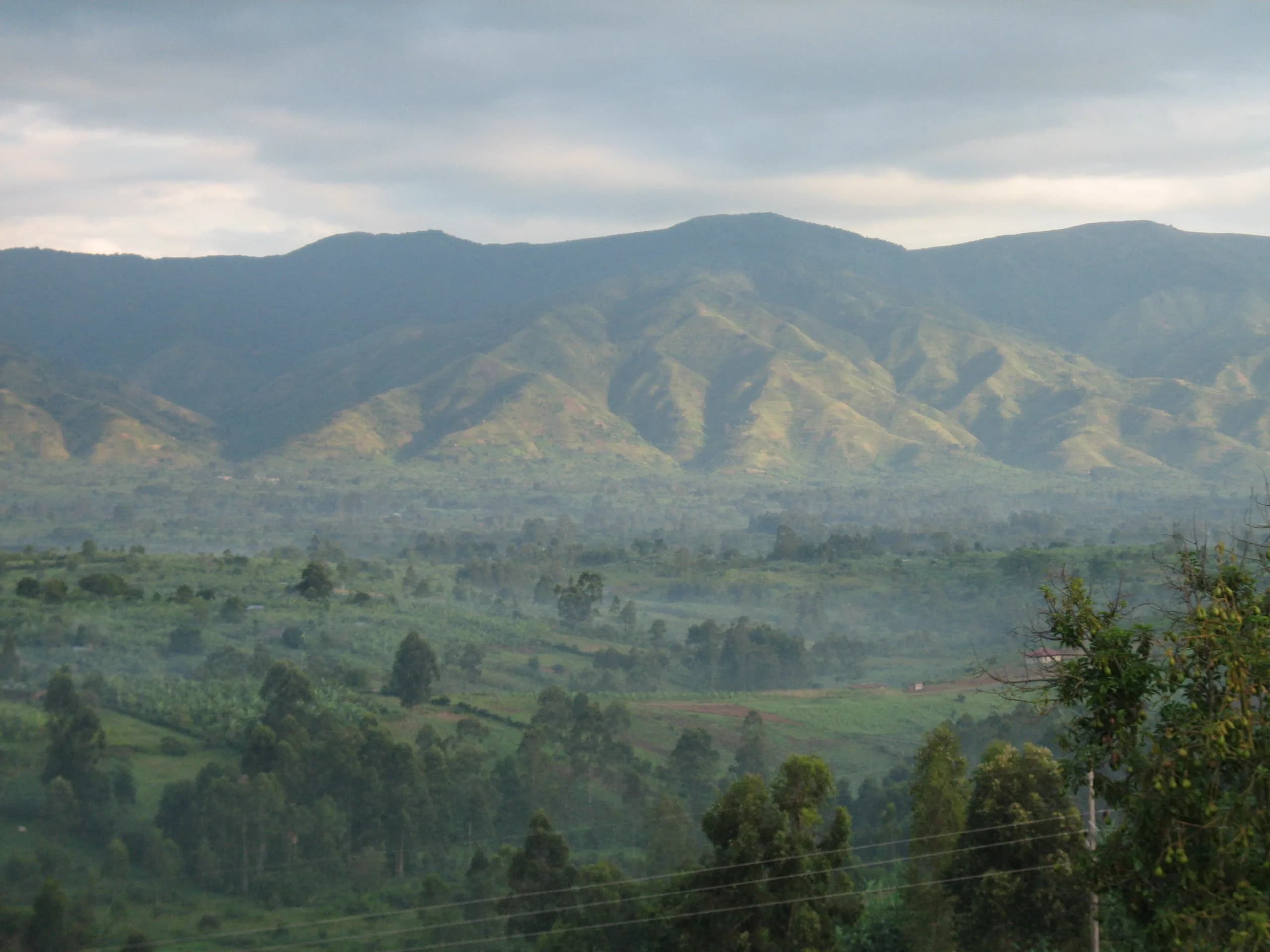
They are different undertakings and it helps not to conflate them. The falls sit on the lower western slopes and take a morning. Mount Elgon is an extinct shield volcano with a caldera roughly forty kilometres across and Wagagai peak at 4,321 metres on the Ugandan side, and reaching the top is a three to four day trek with camping, cold nights and real altitude gain. The Sipi trail into the park starts at Kapkwai, about a forty-minute drive above the village.
One structural point is easy to miss: the mountain straddles the Uganda-Kenya border, and there is a national park on each side run by a different authority. The Kenyan side falls under the Kenya Wildlife Service, which prices Mount Elgon National Park, Kenya, in its Scenic Parks band at USD 50 per non-resident adult per day, under the fees regulations gazetted as Legal Notice No. 160 of 2025. Two countries, two tickets, two sets of rules, each revised on its own authority's schedule.
If you want the summit, give it its own days. It does not work as a bolt-on to a wildlife itinerary.
What happens on a coffee tour on the slopes?
The slopes below the falls are arabica country, grown roughly between 1,600 and 2,000 metres, farmed in small plots by households rather than by estates, and sold abroad under the Bugisu name or as Sipi Falls. A farm tour is arranged through the same village association as the walks, takes two to three hours, and follows the whole chain on one smallholding: the trees under shade, picking, pulping, drying, hulling, roasting in a pan over a fire, pounding, and drinking the result where it was grown.
What stage you actually see depends on where the harvest has got to, so we check with the host before promising a specific activity. On the Elgon slopes the harvest runs roughly from October into February depending on altitude, and a visit inside that window means watching the crop worked rather than described. There is no published tariff for any of it: the tour is arranged and priced locally, and we confirm it at quote stage. The advantage of that arrangement is that the money reaches the household directly, which is not true of most things you pay for on a safari.
How does Sipi fit into a Uganda itinerary?
Geographically it does not sit on the standard circuit. Uganda's headline wildlife is west and north; Sipi is east, near the Kenyan border. It is not a detour off a gorilla trip, it is its own leg, and pretending otherwise is how a beautiful day gets spent in a vehicle.
- It pairs naturally with Jinja and the source of the Nile, about three hours down the road.
- It works as a staging point if you are heading north toward Kidepo Valley, the other Ugandan trip that rewards people willing to travel for it.
- Two nights is the shape that works. One night means arriving tired, walking, and leaving.
- On a short, gorilla-focused trip, Sipi is the first thing we would suggest cutting. We would rather say that than sell you a long drive.
See the Uganda grand circuit for how a longer route is assembled, and what to pack for a gorilla trek for the kit list — the footwear and waterproof advice transfers here directly.
How we handle it
We book the guides, set the day's route around the weather rather than a fixed schedule, and itemise every fee so that nothing turns up as an unexpected cash payment at a trailhead. Where a figure is set locally, or where a national tariff has run past its printed validity, we say so plainly and confirm the live rate before you travel. Start at plan your safari and tell us how many days you actually have. If Sipi does not fit them, we will tell you that too.