

Uganda, cultural site
Amabere ga Nyina Mwiru
Stalactites, a waterfall you walk behind, and the Chwezi story that gives them their name
About Amabere ga Nyina Mwiru
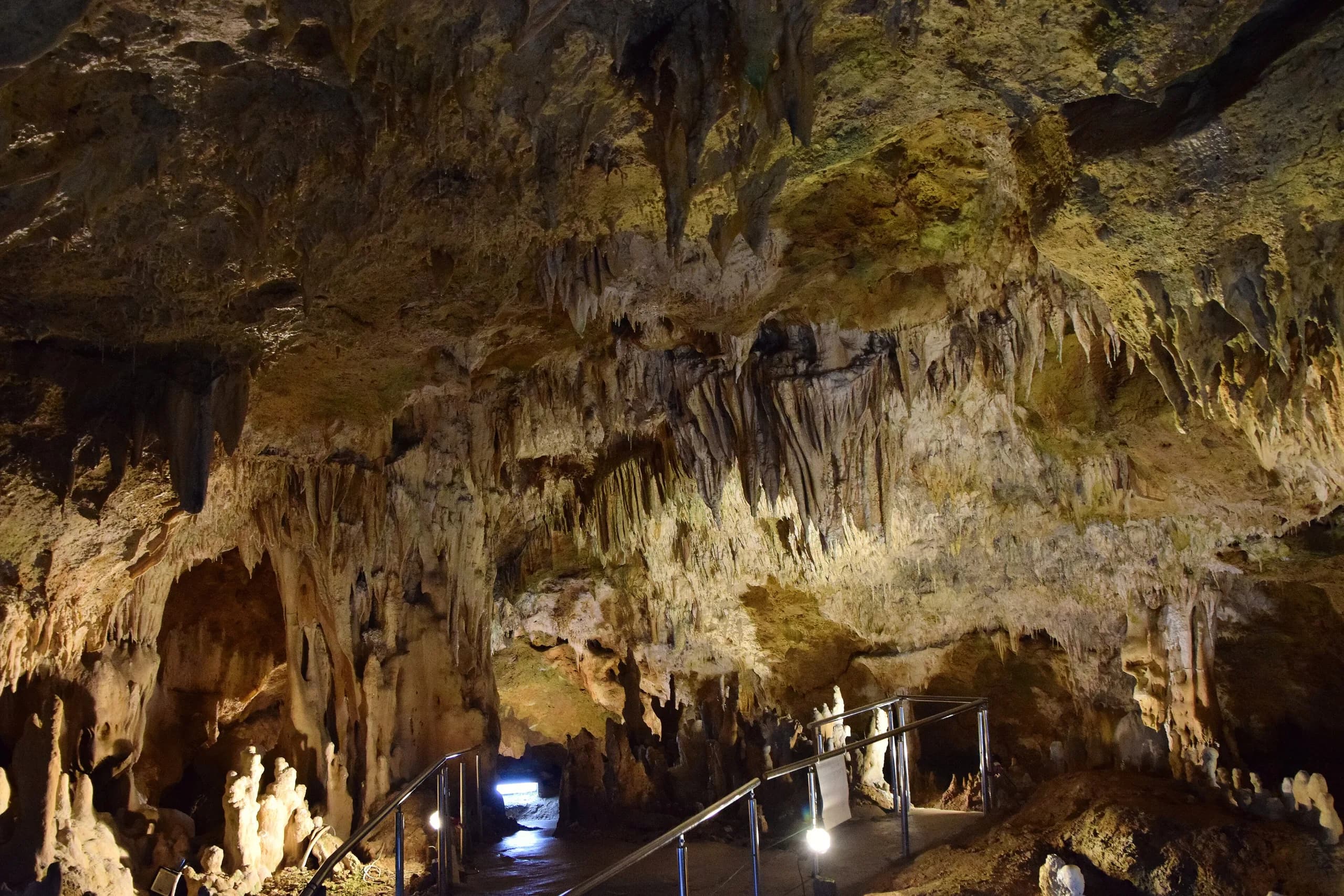
Amabere ga Nyina Mwiru means the breasts of Nyinamwiru, and the name belongs to a cluster of stalactites hanging in a shallow limestone cave a few kilometres north-west of Fort Portal, at Nyakasura. White calcite-laden water beads on the tips of them and drips continuously, and the resemblance is close enough that the name has stuck for as long as anyone has been recording names here.
The story attached to it is a Chwezi one. Nyinamwiru was the daughter of King Bukuku, and a prophecy said that her son would kill him. In the versions told at the cave, Bukuku confined her and had her mutilated so that no suitor would take her, and she bore a son anyway. That son, Ndahura, was raised away from the court, returned, killed Bukuku and became the first of the Chwezi kings. The dripping stone is read as her milk, which is why the site is a shrine as much as a viewpoint.
The caves sit directly beside the Nyakasura falls, a small waterfall dropping over the mouth of the cave that you walk behind on the way in, and the standard visit adds a climb up to the rims of the crater lakes immediately above. It takes about ninety minutes, it is a short drive out of Fort Portal, and it works best as a half day rather than a destination in its own right.
The cave, and the story told in it
The cave is a shallow overhang rather than a system, and you are in and out of it in twenty minutes. What holds you there is the guide, because the visit is essentially a told story with the rock as the illustration: the stalactites, the smaller formations read as the child and the drum, and the calcite crust on the wall. Bukuku belongs to the Batembuzi, the dynasty that Tooro and Bunyoro oral history places before the Bachwezi, and Ndahura is the first Chwezi king. Versions of the story differ in detail from teller to teller, which is normal for oral history and is worth hearing rather than correcting.
The site is still treated as a shrine by some visitors and offerings are sometimes left. Behave accordingly, ask before photographing anyone, and do not touch the formations. The calcite is soft and hands ruin it.
Nyakasura falls
The falls drop over the lip of the rock directly in front of the cave mouth, so the path in takes you behind the water. It is a small fall rather than a large one, the rock underfoot is wet limestone and is genuinely slippery, and the steps down from the car park are steep and uneven. Grip on your shoes matters more here than anything else you bring. In the wet months the spray reaches the cave and everything is soaked.
Fees, and who sets them
The site is on community land and is run by a local association, not by the Uganda Wildlife Authority and not by the Tooro kingdom. There is a single entry fee, set locally, in the modest band that community sites in this region charge, and a guide is included in it rather than extra. Foreign visitors pay more than Ugandans, as at every site in the country. The figure is indicative and the association revises it on its own schedule, so treat it as pocket money rather than a line item, and carry small Ugandan notes because there is no card facility at the gate. Tip the guide separately.
The crater walk above the cave
Most visitors stop at the cave and leave, and they should not. The guided visit extends into a walk up onto the rims above the site, taking in the viewpoints over the nearby crater lakes and, on a clear morning, the Rwenzori peaks to the south-west. That climb is what turns a twenty-minute stop into a proper half day, it costs nothing extra beyond the guide already included, and it is the part people remember. Allow ninety minutes to two hours for the whole thing and say at the gate that you want the long version.
Where it fits, and what it is not
This is a stop, not a stay. It is about fifteen minutes from Fort Portal town, so it slots into the morning you leave for Kibale or the afternoon you arrive from Kampala, and it pairs naturally with the Karuzika palace of the Tooro kingdom on the hill in Fort Portal and with the Ndali and Kasenda crater field south of town. Anyone arriving expecting a large cave system will be disappointed within five minutes. Anyone arriving for the story, the falls and the climb above it will have a good morning.
What people come here for
- The stalactite formations that give the site its name, and the story of Nyinamwiru told at the rock
- The path in behind the Nyakasura falls, straight through the spray
- A local guide who tells the Chwezi history rather than reciting a script
- The climb to the crater rims above the cave, the part most visitors skip
- Rwenzori peaks to the south-west from the top on a clear morning
- Fifteen minutes from Fort Portal, so it fits either end of a Kibale trip
What lives here
Resident species, not a promise. Wildlife moves.
- Egyptian fruit bat
- Vervet monkey
- Black and white colobus
- Tree hyrax
- Great blue turaco
- Ross’s turaco
- Black and white casqued hornbill
- Grey crowned crane
- Pied kingfisher
- African harrier-hawk
Best time to visit
The site is open all year and the visit works in any month. December to February and June to August are drier and the limestone steps and the path behind the falls are far less treacherous, which matters more here than at most Ugandan sites because the whole approach is wet rock. March to May and September to November bring the two rainy seasons, the falls run harder, the spray reaches the cave and the climb to the crater rims turns into a mudslide. Mornings are the better half of the day in every month, both because the light reaches into the cave mouth and because the Rwenzori peaks from the rims above are only visible before the cloud builds.
Getting there
The caves are a few kilometres north-west of Fort Portal at Nyakasura, roughly fifteen minutes from the town centre on a short murram turning off the Bundibugyo road, and any boda or taxi in Fort Portal knows the site by name. Fort Portal itself is five to six hours from Kampala via Mubende on tarmac, two hours north of Queen Elizabeth through the crater lake field, and about forty minutes north of the Kanyanchu chimpanzee tracking point in Kibale. By air, Aerolink flies Entebbe to Kasese in about an hour and the road transfer north to Fort Portal is a further ninety minutes, which only makes sense if you are already flying the western circuit.
Around Amabere ga Nyina Mwiru
Tell us when you want to be here
We will say honestly what is available on your dates, what the permits cost and whether the season suits what you want to do in Amabere ga Nyina Mwiru.